
Table of Contents
KEY TAKEAWAYS
- WHO recommends zero screen time for children under 2 and a maximum of 1 hour per day for children aged 2 to 5.
- Screen exposure before age 5 is associated with delayed language development, shorter attention spans and disrupted sleep, per WHO 2019 guidelines.
- A screen-free preschool in Baner Pune replaces screens with sensory play, storytelling, peer interaction and outdoor activity – all of which are developmentally superior for this age group.
- EidosKids was founded with zero screens as one of five non-negotiable principles, based on developmental psychology research.
- Children in screen-free environments show stronger social skills and higher creative problem-solving ability by age 5 (PubMed, multiple studies).
- Parents can reinforce the school’s zero-screen policy at home with simple activity substitutions.
The zero-screen policy applies to all teaching tools at EidosKids – no smartboards, no tablets and no digital games.
QUICK FACTS
- WHO recommended screen time under 2 years: Zero
- WHO recommended screen time ages 2 to 5: Maximum 1 hour per day
- EidosKids screen policy: Zero screens in all learning environments
- Average daily screen time for Indian children aged 2 to 5: 2.5 to 3.5 hours (Industry estimate)
- Key skill impacted by excess screen time: Language development (WHO 2019)
EidosKids policy applies to: Tablets, smartboards, digital games, TV and teacher-used devices
Pune Preschool Screen Policy Statistics 2025-2026
| Metric | Data | Source |
| WHO maximum screen time for ages 2 to 5 | 1 hour per day of high-quality content | WHO Guidelines on Physical Activity and Sedentary Behaviour 2019 |
| Association between screen time over 2hrs/day and language delay | Significant positive association | PubMed – Chonchaiya & Pruksananonda, 2008 |
| Average screen exposure for Indian under-5s | 2.5 to 3.5 hours daily | Industry estimate |
| Preschools in Pune using smartboards in lower KG | Approximately 65 percent | Industry estimate |
| Improvement in attention span in screen-free vs screen-based environments | Reported by multiple longitudinal studies | PubMed – multiple studies cited by WHO |
| Association between screens before bed and disrupted sleep in toddlers | Consistent across 14 studies reviewed | WHO 2019 Systematic Review |
Playgroup vs Nursery: Which Is Right for Your 2-Year-Old?
| Factor | Playgroup | Nursery |
| Typical entry age | 2 to 2.5 years | 2.5 to 3 years |
| Daily session length | 2–3 hours | 3–3.5 hours |
| Structured learning time | Minimal – 10–15 min | 30–45 min |
| Primary focus | Social-emotional, sensory | Pre-literacy, pre-numeracy |
| Language needed | 20–30 words sufficient | 50+ words preferred |
| Separation readiness | Low – gentle transition | Moderate – short separation managed |
What WHO Actually Says About Screens and Toddlers
The World Health Organisation published its guidelines on screen time for children under 5 in 2019 and the message is clear. For children under 2, the recommendation is zero screen time. For children aged 2 to 4, the maximum is one hour per day and the guidance specifies that this should be high-quality, interactive content watched with a caregiver – not passive solo viewing.
These guidelines weren’t created to be restrictive. They were developed because the evidence showed something important: the activities that screens replace in a young child’s day – physical play, face-to-face conversation, sensory exploration, creative construction – are the activities that drive language, social and cognitive development most effectively at this age. Screens don’t add to a young child’s developmental environment. They displace something better.
Why does this matter for preschool? Because a child who attends school from 8am to 12pm spends roughly a quarter of their waking day in that environment. The choices a school makes about how to fill that time have a measurable impact.
How Screens Actually Affect the Developing Brain
The concern about screens isn’t about content alone. It’s about mechanism. When a toddler watches a screen, the interaction is one-directional. The screen doesn’t respond to the child’s facial expression, adjust to their confusion or slow down when they look away. It delivers stimulation at a fixed pace that the child’s brain can’t influence.
Face-to-face conversation does the opposite. When a child speaks to a teacher, the teacher responds, pauses, mirrors the child’s expression and adjusts their language based on what they see. This back-and-forth is the single most powerful driver of language development in children under 5, according to research published in PubMed’s early language acquisition literature.
Sensory play – clay, sand, water, building blocks, paint – activates fine motor development, spatial reasoning and problem-solving through the hands. These are neural pathways that a screen cannot activate regardless of how well-designed the app is.
A father from Hinjewadi who visited EidosKids asked a direct question: “If you don’t use technology, how do children develop digital skills?” The answer from co-founder Taiba Patel was equally direct. Children aged 2 to 6 don’t need digital skill development. They need the foundational cognitive skills that will allow them to use any technology effectively later – attention, language, spatial reasoning, social intelligence. Those skills are built through play, not screens.
What a Zero-Screen Day at EidosKids Actually Looks Like
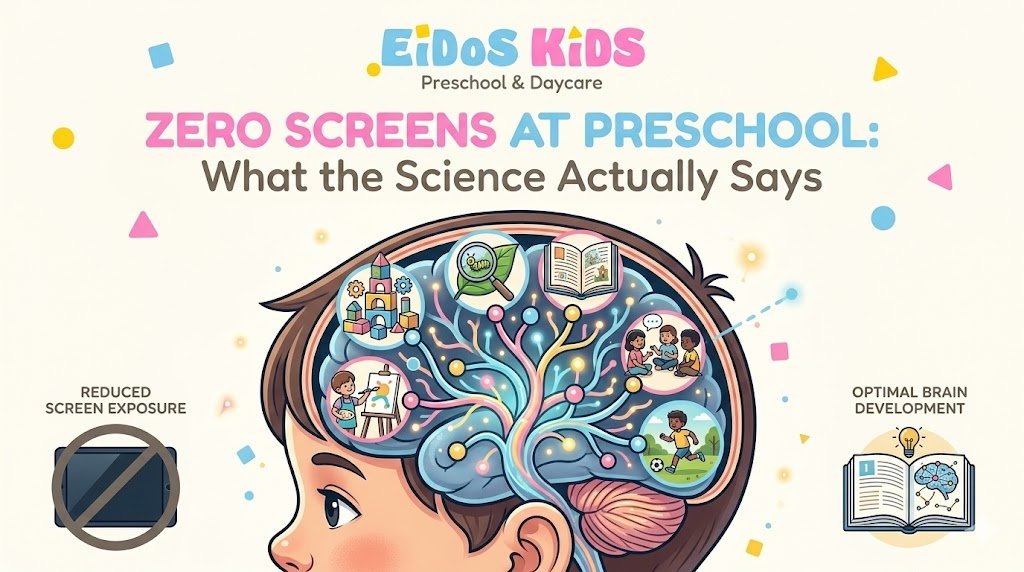
Removing screens from a preschool classroom isn’t a subtraction. It’s a replacement with something that takes more planning, more materials and more teacher engagement. At EidosKids, a typical Playgroup or Nursery morning includes sensory play stations (sand, water, clay, natural materials), open-ended construction play with blocks and loose parts, outdoor exploration in the school’s designed outdoor area, story time with physical books and props and a guided activity session.
Each of these activities is chosen because it does something specific for brain development that screens cannot replicate. Clay strengthens the fine motor pathways used later in writing. Outdoor exploration builds proprioceptive awareness and spatial memory. Story time with a live reader – with pauses, questions and facial expressions – builds vocabulary and comprehension in ways that recorded audio cannot.
The zero-screen policy also applies to teacher tools. EidosKids does not use smartboards, tablets for teaching demonstrations or digital games as rewards. This is a deliberate signal to children that learning happens between people, not between a person and a device.
What Research Says About Screen-Free Learning Environments
Multiple studies cited in WHO’s 2019 systematic review found that children in lower-screen environments showed stronger vocabulary at age 5, better emotional regulation and higher scores on executive function tasks like attention and working memory compared to children with high daily screen exposure.
A 2019 PubMed study followed 2,441 children from age 2 through 5 and found that children whose screen time exceeded 2 hours per day had significantly lower scores on developmental screening tests for communication and problem-solving. These weren’t children in unusual circumstances – they were average children in average homes with average screen habits.
What does this mean for a parent in Baner? It means the hour your child spends watching YouTube before school and the hour they spend watching TV after school is already approaching or exceeding the WHO daily maximum. Sending them to a school where those hours are filled with screens would compound a pattern that the evidence suggests is worth managing carefully.
How Parents Can Support the Zero-Screen Approach at Home
A screen-free preschool has the most impact when parents align with its philosophy at home. This doesn’t mean zero screens at home – it means being intentional about when and how screens appear in a young child’s day.
The most effective substitutions are simple. Replace morning screen time with a 15-minute drawing or playdough session. Replace post-school screen time with outdoor play, reading aloud or an open-ended building activity. Keep mealtimes screen-free so conversation can happen. These aren’t restrictions – they’re investments in the same developmental outcomes the school is building every day.
Taiba Patel works directly with EidosKids families on exactly this kind of home-school alignment. The school’s parent education programme includes guidance on screen management at home as a component of holistic child development support.
Screen-Free Preschool in Baner and Surrounding Areas of Pune
Baner, Pashan, Balewadi and the Hinjewadi tech corridor represent one of Pune’s most digitally engaged parent communities. Many EidosKids parents are software engineers, product managers and UX designers – people who work with screens all day and who, perhaps more than anyone, understand both the power and the limits of digital tools.
Interestingly, this demographic is among the most receptive to the zero-screen preschool approach. When your professional context involves screens constantly, the desire for your child’s early years to be grounded in something more tactile and social is intuitive. Several Baner parents who visited EidosKids specifically mentioned the no-screen policy as a reason they chose the school.
EidosKids is located on Baner Road, Pune 411045 and serves children from Baner, Baner Gaon, Sus Road, Pashan and Wakad. The screen-free policy applies from the moment children enter the campus to the moment they leave – with no exceptions for special events, bad weather days or digital literacy activities.
The Screen-Free Choice in 2026
The science on screens and young children is not ambiguous. The debate in developmental psychology isn’t whether screens affect young children – it’s about how much exposure is too much and what it displaces. A screen-free preschool in Baner Pune makes a clear, evidence-based bet: the best use of a 2 to 5-year-old’s time at school is not digital and it never will be.
EidosKids was built by people who read the research and then designed a school around its conclusions. If you want to see what a zero-screen school day looks like for your child, book a visit at https://eidoskids.com/contact. The co-founders Taiba Patel and Smita Patil are directly involved in showing families around the campus and answering exactly these kinds of questions.
DISCLAIMER: This blog post is for informational and educational purposes only. It is not a substitute for professional medical, developmental or psychological advice. Parents concerned about their child’s development or screen habits should consult qualified child development specialists. EidosKids is a registered preschool at Baner Road, Pune 411045.
Frequently Asked Questions
-
What is a screen-free preschool and what does it mean in practice?
A screen-free preschool is one where no digital screens – tablets, smartboards, televisions, digital games or phones – are used during the school day, by either children or teachers for instructional purposes. At EidosKids in Baner, this means children spend their entire school day in screen-free activities including sensory play, outdoor exploration, art and craft, story time and peer play.
-
What does WHO say about screen time for children under 5?
WHO’s 2019 guidelines recommend zero screen time for children under 2 years and a maximum of one hour per day for children aged 2 to 4. The guidelines emphasise that this hour should be high-quality, caregiver-interactive content, not passive solo viewing. These guidelines are based on evidence showing that excess screen time displaces more beneficial developmental activities.
-
Does a screen-free policy mean children won’t be prepared for technology later?
No. The foundational cognitive skills that children develop through play – attention, problem-solving, language, spatial reasoning and social intelligence – are the same skills that enable effective technology use later in life. Children who develop strong executive function through play are better prepared for technology learning at primary school age, not less prepared.
-
What does EidosKids do instead of screens?
EidosKids replaces screens with sensory play stations, open-ended construction, outdoor exploration, live story time with physical books, art and craft using natural materials, music and movement and guided group activities. Every screen replacement is chosen because it activates specific developmental pathways that screens cannot.
-
How do I manage screen time at home if my child is in a screen-free preschool?
EidosKids’ parent education programme provides specific guidance on home screen management. General recommendations include keeping mealtimes screen-free, replacing morning screen time with a brief physical or creative activity and reading aloud for 15 minutes before bed instead of screen time. Small changes in routine are more sustainable than total bans at home.
-
Are screens ever used at EidosKids for any purpose?
No. EidosKids’ zero-screen policy applies to all spaces and all uses during the school day – including teacher demonstrations, weather-day activities and special events. The policy is a founding non-negotiable, not a flexible guideline.
