Here is what most nursery school pages in Baner do not tell you.
Separation anxiety at preschool drop-off is not a sign that something is wrong with your child. It is a sign that something is right. A child who protests separation has formed a strong primary attachment – and that attachment is the single most important predictor of healthy social and emotional development through childhood.
The question is not whether your child will go through separation. Every three-year-old does. The question is whether their nursery school knows how to handle it properly, with the developmental science to back up what they do.
At EidosKids, we do. And this page will show you exactly how.
A three-year-old is not a scaled-down school student. They are a human being in the middle of four simultaneous developmental transformations, each of which changes what they need from the adults around them.
The Four Developmental Shifts at Age 3 to 4
without the safety net of siblings or parents for the first time
learns now shape how they think and communicate for years
push for independence that needs to be channelled, not suppressed
hold ideas in their minds and manipulate them, the basis of all future abstract thinking
Each of these shifts requires a specific kind of environment and a specific kind of adult response. Generic early education programmes do not differentiate by developmental stage. EidosKids Nursery is built around all four.
The pressure to introduce phonics, number work and structured lessons to three-year-olds is common in Pune’s preschool market. It is also developmentally misaligned.
A three-year-old’s prefrontal cortex – the region responsible for reading, numeracy and formal learning – is in early development. Pushing academic content before the brain is ready does not accelerate development. It creates anxiety, avoidance and a negative association with learning that can persist into primary school.
The EidosKids Nursery programme is deliberately non-academic in the traditional sense. It is intensive in the developmental sense. Every activity is designed to build the social, emotional and cognitive foundation that academic learning later depends on.
Most nursery schools in Baner treat separation anxiety as a problem to be managed. EidosKids treats it as developmental information.
A child who cries at drop-off has a secure primary attachment. That attachment is the foundation of every positive relationship they will ever form. The goal is not to eliminate the protest quickly. The goal is to help the child build a secondary secure base – the nursery environment – so that they can explore confidently from two secure anchors instead of one.
Children who are rushed through this process, or whose anxiety is minimised or ignored, often show the consequences later: social withdrawal, clinginess at home and difficulty trusting new environments.
What EidosKids Does Differently in the First Two Weeks of Nursery
The first two weeks at EidosKids are not ‘settling-in.’ They are a structured attachment-building process.
Not worksheets. Not calendar drills. Not forced circle time. Here is what the Nursery year at EidosKids actually builds, domain by domain.
Before a child can learn, they need to feel safe. Before they can feel safe in a new environment, they need a reliable relationship with someone in that environment. This is attachment security – and it is the single most researched predictor of positive outcomes across cognitive, social and emotional development.
EidosKids Nursery is designed around this finding. Small groups, consistent caregivers, predictable routines and an environment where a child’s signals are read and responded to accurately – these are not comfort measures. They are the architecture of a learning-ready brain.
Social Navigation: Sharing, Turn-Taking and Conflict Resolution
Three-year-olds are encountering sustained peer interaction for the first time. The social rules that adults take for granted – sharing, waiting, negotiating, apologising and reading other people’s signals – do not come naturally. They have to be learned, practised and coached.
EidosKids educators are trained in social navigation coaching. They do not just intervene in conflicts. They narrate what is happening, offer vocabulary for the situation and guide children toward resolution in a way that builds the skill, not just ends the immediate problem.
A child who cannot name what they are feeling is a child who cannot manage it. Emotional meltdowns in three-year-olds are almost always a vocabulary problem before they are a behaviour problem. When a child learns the words ‘frustrated,’ ‘disappointed’ and ‘worried,’ they gain cognitive control over those states – because naming an emotion activates the prefrontal cortex and reduces the intensity of the emotional response.
At EidosKids, emotional vocabulary is not a lesson that happens once a week. It is woven into every interaction throughout the day. Educators name their own emotions, name what they observe in children and provide the language children need to express themselves accurately.
Physical Development: Gross and Fine Motor Confidence in the Nursery Year
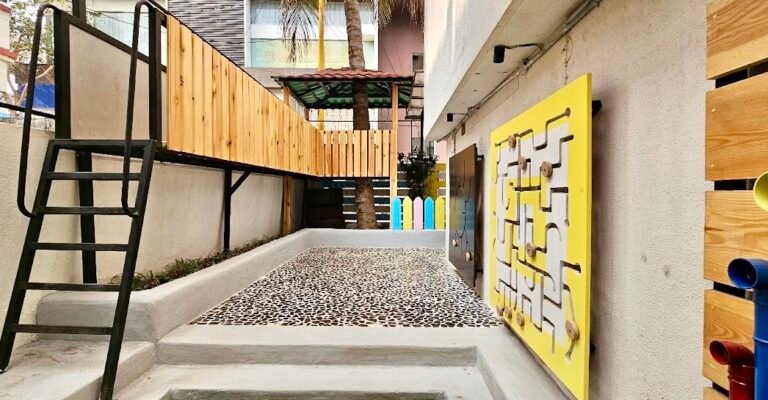
Physical development is not separate from cognitive development at age 3. The neural pathways built through large-body movement – climbing, jumping, balancing, rolling – are the same pathways that support spatial reasoning, impulse control and later handwriting readiness.
EidosKids maintains continuous individual tracking across six developmental domains for every Nursery child. This is not an end-of-term report. It is ongoing, responsive monitoring that changes how educators interact with each child day to day.
| Developmental Domain | What Is Tracked | Why It Matters |
|---|---|---|
| Separation and attachment security | Comfort with drop-off, ability to self-settle, response to educator presence | Foundation of all learning – must be established before cognitive work can happen |
| Peer interaction quality | Initiation, cooperation, conflict responses, empathy signals | Predicts social competence through primary and secondary school |
| Emotional regulation | Range of emotion vocabulary, self-regulation strategies, adult-support needs | Strong emotional regulation predicts academic persistence and resilience |
| Language complexity | Vocabulary breadth, sentence length, narrative ability, comprehension | Language at age 4 is the strongest predictor of reading at age 8 |
| Fine and gross motor milestones | Hand strength, pencil grip readiness, balance, coordination, body awareness | Physical development directly supports cognitive and academic readiness |
| Attention span and focus | Sustained engagement time, transition adaptability, self-directed play depth | Attention at age 4 predicts executive function at age 7 and beyond |
When a child’s developmental profile shows that language is accelerating but social initiation is hesitant, their day at EidosKids changes. Educators create small-group situations that require low-stakes social interaction. They use that child’s language strength to scaffold social connection. The activities are still play-based. But they are targeted play-based.
This is what ‘responsive, not standardised’ means in practice. Every child gets the same high-quality environment. Not every child gets the same experience within it.
What Age Can My Child Start Nursery at EidosKids?
The EidosKids Nursery programme is for children aged 3 to 4 – children who are 3 years old as of the start of the academic year. Children who turn 3 between June and December of the admission year are considered for the current cohort. Children turning 3 after December are recommended for the following year’s Nursery intake or for the First-Step Playgroup as a bridge.
Parents who want their child to be assessed for readiness before committing to a start date are welcome to request a developmental consultation during a campus visit.
Is the EidosKids Nursery Accessible from Wakad, Aundh and Pimpri-Chinchwad?
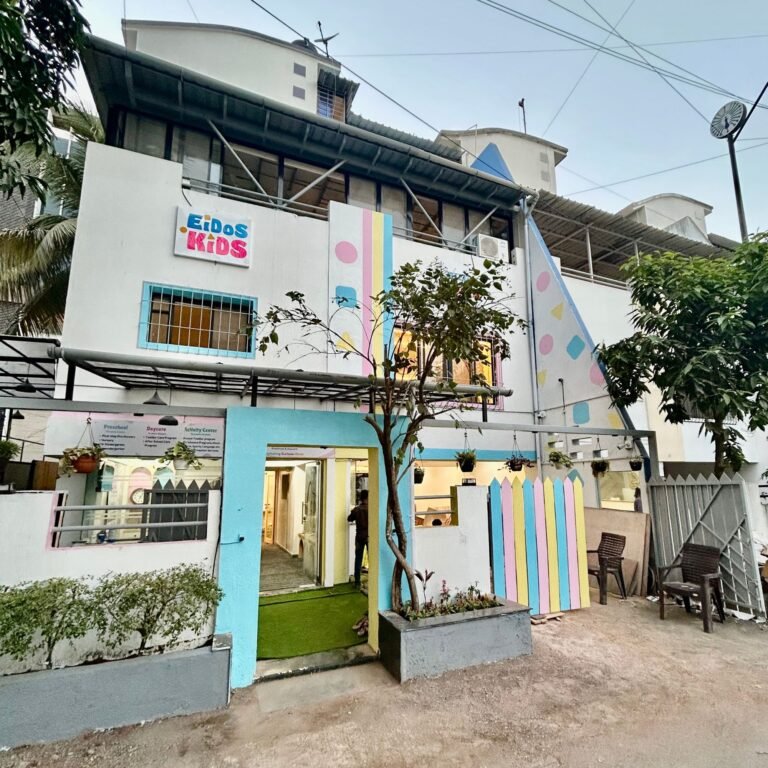
Yes. EidosKids Nursery is located on the main Baner road, accessible to families from Wakad, Aundh, Balewadi, Pashan, Sus Road, Pimple Saudagar and the Pimpri-Chinchwad area. The safe-pickup service from the main road bus stop and auto point means families from the Hinjewadi IT corridor can also manage the morning commute without a separate drop-off trip.
Families from Pimpri-Chinchwad looking for a play-based nursery with organic meals, zero screens and transparent fees often choose EidosKids specifically because the Baner road location makes the commute manageable by either the Expressway or the link road.
A: In India, nursery school is typically for children aged 3 to 4 years. At EidosKids in Baner, Pune, the Nursery programme accepts children who are 3 years old at the start of the academic year. Children who are not yet ready for Nursery – either due to age or developmental stage – can join the First-Step Playgroup programme for children aged 2 to 3. EidosKids recommends a campus visit with your child before confirming admission so the team can assess developmental readiness directly.
A: EidosKids treats separation anxiety as developmental information, not a behaviour problem. Each Nursery child is assigned a consistent key educator from day one. Drop-off routines are kept short, consistent and predictable – the same sequence every morning reduces anxiety faster than any other approach. Parents receive a daily update on their child’s specific emotional state, not a generic report. Most children who struggle at drop-off in the first week are running into class independently within two weeks when the attachment-building process is handled correctly.
A: Yes. EidosKids Nursery is on the main Baner road, accessible from Wakad, Aundh, Balewadi, Pashan, Sus Road and Pimple Saudagar. The school runs a safe-pickup service from the main road bus stop and auto point, which working parents from the Hinjewadi IT corridor and Pimpri-Chinchwad area use regularly. Contact EidosKids at +91-88060 06699 or info@eidoskids.com to discuss pick-up logistics for your specific location.
A: No. The EidosKids Nursery programme does not use worksheets, phonics drills, number practice or any form of structured academic instruction with 3-year-olds. The developmental science on this is clear: a three-year-old’s brain is not yet ready for formal academic input. Pushing it creates anxiety and negative associations with learning. EidosKids Nursery focuses entirely on the social, emotional, language and physical foundations that academic learning depends on later – through play, sensory experience and responsive educator interaction.
A: The EidosKids Nursery fee is all-inclusive. It covers all learning materials and books, school uniform, freshly prepared organic meals and snacks daily, all activities and outings, individual developmental tracking and written parent updates, and access to parent workshops. There are no separate meal charges, no extra costs for activities and no mid-year fee requests. The fee quoted at admission is the fee you pay. Contact EidosKids directly at +91-88060 06699 for current fee details, as these are reviewed annually.
Best Preschool & Daycare in Baner. Empowering kids through innovative, play-based holistic learning.