Table of Contents
Key Takeaways
- The best craft activities for children require no expensive materials — paper, glue, paint, and natural items from around the house are enough.
- Craft activities build fine motor skills, hand-eye coordination, concentration, and creative problem-solving in children aged 2 to 6.
- Process matters more than the final product — children learn most when they explore freely without pressure to produce a ‘perfect’ result.
- Sensory crafts (clay, sand art, texture collages) are especially powerful for toddlers and preschoolers building early neural pathways.
- Combining craft time with conversation deepens language development alongside creativity.
Why Craft Activities Matter More Than You Think
Pick up a piece of paper and a pair of child-safe scissors and hand them to a three-year-old. Watch what happens. The concentration on that small face, the grip adjustments, the tiny tongue that appears when things get tricky — that is a child’s brain building real capability.
Easy craft ideas for children are not just a way to keep kids occupied on a rainy afternoon. Every cut, fold, stick, and smear of paint is a developmental act. Fine motor muscles are strengthening. Cause-and-effect thinking is forming. Aesthetic sensibilities are beginning to take shape. And behind all of it, confidence is building — the confidence that comes from making something that did not exist before.
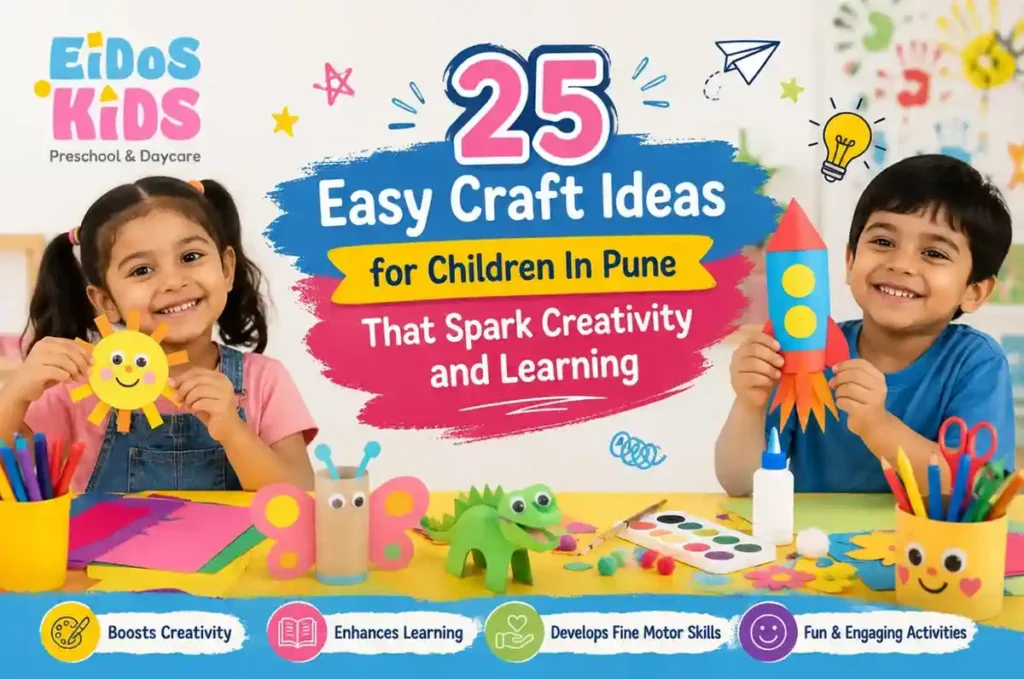
This guide gives you 25 craft activities for children aged 2 to 6, organized by age group and skill level, using materials available in most Indian homes. Each activity includes a note on what your child is actually developing — because knowing the ‘why’ makes craft time far more intentional.
Quick Facts: Crafts and Child Development
| Craft Skill | What It Builds | Best Age Range |
| Tearing and crunching paper | Grip strength, bilateral coordination | 2-3 years |
| Painting with fingers | Sensory processing, color recognition | 2-4 years |
| Cutting with scissors | Fine motor control, task focus | 3-5 years |
| Collage making | Spatial reasoning, creative composition | 3-6 years |
| Threading and lacing | Hand-eye coordination, sequencing | 4-6 years |
| Clay and dough sculpting | 3D spatial thinking, tactile sensitivity | 2-6 years |
| Drawing and doodling | Pre-writing skills, visual expression | 2-6 years |
Easy Craft Ideas for Children mostly for Toddlers (Ages 2-3): Sensory First, Structure Later
With children under three, the goal is exploration. Worry less about the finished product and focus entirely on the experience. Messes are learning. Repetition is research.
1. Finger Painting on Paper Bags
Turn brown paper bags inside out and let your toddler paint freely with washable poster colours. The coarser texture of the bag adds a sensory layer that flat paper cannot provide. Name the colours as they mix to build early language alongside motor skills.
2. Torn Paper Collage
Materials needed: Old magazines, newspapers, child-safe glue stick, and a sheet of cardboard. Let your toddler tear freely — no cutting required. Tearing paper uses both hands simultaneously and builds the bilateral coordination that later supports writing.
3. Salt Dough Shapes
Mix one cup of flour, half a cup of salt, and half a cup of water to make a simple no-bake dough. Children roll, press, and shape it freely. Bake at a low temperature for two hours and they have a keepsake. This craft introduces texture, pressure, and basic physics (pressing harder makes a deeper mark).
4. Leaf and Flower Printing
Collect leaves, flowers, or seed pods from your garden or a walk around the neighbourhood. Brush poster paint on one side and press onto paper. Lift carefully to reveal the print. Each print is unique, which teaches children that variation in nature is not a mistake — it is a feature.
5. Cotton Ball Clouds
Spread glue on blue construction paper and let your toddler press cotton balls into whatever shapes feel right. Follow with a conversation about clouds, sky, and rain. This craft takes five minutes and naturally opens into science, storytelling, and weather vocabulary.
6. Bubble Wrap Stamping
Dab paint onto a piece of bubble wrap and press it onto paper for a polka-dot pattern. The satisfying texture of bubble wrap makes this a craft that children will request again and again. Cut the bubble wrap into shapes — circles, stars, hands — for more controlled outcomes.
Crafts for Nursery Age Children (Ages 3-4): Introducing Tools and Purpose
At three to four years, children begin to have intentions for their craft. They say ‘I am making a butterfly’ before they start, and they feel invested in seeing that intention take shape. This is when you can introduce child-safe scissors, stickers, and simple folding.
7. Paper Plate Animals
A paper plate becomes a face, a sun, a lion, or a fish depending on what you stick to it. Use paint, paper strips, tissue paper, and googly eyes. The child chooses the animal, which means they are making their first independent creative decisions — a genuinely significant cognitive step.
8. Handprint Art
Press the child’s hand into paint and stamp it onto paper. The thumb becomes a sun ray. The fingers become tree trunks. The palm becomes a butterfly body. Handprint art doubles as a developmental record — parents who keep a series of these have a visual timeline of their child’s physical growth.
9. Ice Cream Stick Picture Frames
Glue four ice cream sticks (available in any craft supply or stationery shop) into a square. Decorate with paint, beads, or small sticker gems. Slide a photograph behind and display. Children who make their own frames take enormous pride in the result — especially when it goes up on the family wall.
10. Newspaper Boats
Fold a double-page sheet of newspaper into a boat shape — this is one of the simplest origami forms. Let your child paint or colour their boat before the folding, so they are decorating a flat sheet that they then watch transform into a 3D object. Take the boat to a bucket of water to test whether it floats.
11. Pasta Necklaces
Thread tubular pasta (penne or rigatoni) onto a piece of wool or thick string. Paint the pasta first if you want colour, or leave it natural for a textural necklace. Threading activities are among the most effective fine motor exercises available for this age group. They directly develop the pincer grip used in holding a pencil.
12. Sticker Scene Making
Give your child a blank sheet of paper and a collection of sticker dots, stars, and shapes. Ask them to make a scene — a garden, a night sky, a face. The limitation of working only with circular stickers forces creative lateral thinking that an open canvas does not.
13. Tissue Paper Suncatchers
Cut small squares of coloured tissue paper and stick them onto a piece of clear contact paper. Add another sheet of contact paper on top. Hang the finished piece in a window. When sunlight passes through, the room fills with coloured light — which is genuinely magical to a four-year-old.
Crafts for Preschoolers (Ages 4-5): Structure, Story, and Skill
Four and five-year-olds can manage multi-step projects. They can plan ahead, follow a sequence, and evaluate their own work. This is the age for crafts that tell a story or serve a purpose beyond decoration.
14. Paper Bag Puppets
A standard paper lunch bag becomes a puppet character in about ten minutes. Draw a face on the folded bottom of the bag, add paper ears, yarn hair, or fabric scraps for clothes. Once the puppet is made, encourage your child to perform a short story with it. Craft and language development in a single activity.
15. DIY Bookmarks
Cut thick paper or old card into bookmark-shaped strips. Let children draw patterns, write their name, or create a character. Laminate with a strip of sticky tape on each side for durability. When a child makes their own bookmark and uses it in a real book, the connection between craft and the wider world of reading becomes tangible.
16. Seed Mosaic Art
Draw a simple shape in pencil on thick paper — a house, a flower, a car. Fill the outline with glue and press different seeds and pulses (moong, rajma, rice, mustard) into the glue to fill the shape. The colour variation between seeds creates natural mosaic effects without any paint required.
17. Rock Painting
Collect smooth pebbles from a garden or park. Clean and dry them. Paint animals, faces, ladybirds, or abstract patterns using acrylic paint. Once dry, place them in a garden or give as gifts. This craft works particularly well for children who are drawn to tactile, weighty materials rather than flat paper.
18. Weather Chart with Paper Elements
Create a simple weekly weather chart together. Draw seven columns on a large sheet of paper, one for each day. Make small paper symbols for sun, cloud, rain, and wind — cut them out and colour them. Each morning, your child adds the correct symbol for the day. Craft becomes a tool for observing the real world.
19. Pinwheel Making
Cut a square of paper, score and fold alternate corners to the centre, push a pin through the centre into an eraser-tipped pencil, and you have a working pinwheel. The mechanics of watching something they made actually spin in the wind creates a genuine sense of engineering achievement in a five-year-old.
Crafts for Junior KG Children (Ages 5-6): Complexity, Planning, and Expression1
At five to six, children are capable of choosing their own themes, planning multi-session projects, and beginning to apply craft skills to functional outcomes. These crafts support the transition toward structured learning environments.
20. Mini Storybooks
Fold four sheets of paper in half and staple along the spine. That is an eight-page book. Ask your child to plan their story before they start — who is the character, what happens, how does it end? Then they illustrate and write (or dictate) each page. Making a real, physical book is one of the most powerful literacy-craft bridges available at this age.
21. Nature Weaving on a Stick Loom
Find two straight sticks of similar length and tie them into a cross shape with string. Wind wool horizontally across the frame, creating a simple loom. Weave in leaves, feathers, flower stems, and strips of fabric. The process of weaving — over and under, over and under — is rhythmic, meditative, and builds sequential thinking.
22. Paper Mache Bowls
Tear newspaper into strips. Mix one part PVA glue with one part water. Inflate a small balloon. Layer strips of newspaper dipped in the glue mix over the bottom half of the balloon. Leave to dry for 24 hours, then pop the balloon. Paint the bowl. This is a multi-day project — exactly the kind of sustained creative engagement that five and six-year-olds are developmentally ready for.
23. Tangram Puzzles
Cut a square piece of card into the seven standard tangram pieces — two large triangles, one medium triangle, two small triangles, one square, and one parallelogram. The pieces can be arranged into hundreds of animal and object silhouettes. Once your child has used a purchased tangram set, making their own means they understand how the shapes were derived.
24. Recycled Instrument Making
Fill small plastic bottles with rice, dal, or small stones to make shakers. Stretch a rubber band across an open box for a simple string instrument. Tap the base of a tin can for a drum. Children who make their own instruments play with them differently — they understand the cause behind the sound because they designed it themselves.
25. Calendar Art Project
Each month, create a piece of artwork that reflects the season — Holi colours in March, monsoon scenes in July, festival lanterns in October, winter flowers in January. Compile twelve pieces into a personal calendar for the following year. This craft teaches planning across time, which is a genuinely sophisticated cognitive skill for a six-year-old.
Making Craft Time More Effective: Practical Tips for Parents
- Set up before you start. Laying out all materials in advance removes mid-activity interruptions that break a child’s concentration.
- Name what you see, not what you judge. Say ‘I see you mixed blue and yellow’ rather than ‘Good job.’ Descriptive language builds vocabulary and keeps children process-focused.
- Accept incompletion. Some children start a project and move on. This is not a problem — it is flexibility and experimentation.
- Photograph the process, not just the product. A picture of your child’s face while they work tells a richer story than the finished craft.
- Rotate materials. The same set of materials produces diminishing creative returns. Introduce one new element each week to reset curiosity.
- Connect craft to real life. A child who made a paper boat should see a real boat. A child who painted a butterfly should look for butterflies in a park. Craft becomes the entry point, not the endpoint.
Frequently Asked Questions
Q1. What craft activities are best for two-year-olds?
Two-year-olds benefit most from sensory craft activities that do not require precise hand control. Finger painting, tearing paper, pressing clay, and stamping with objects all work well. The focus at this age is on experiencing materials rather than producing a recognizable outcome.
Q2. How long should a craft session be for young children?
For children aged two to three, ten to fifteen minutes is typically the upper limit before attention shifts. Four to five-year-olds can sustain focus for twenty to thirty minutes on an engaging project. Six-year-olds working on a multi-step project may sustain interest for forty-five minutes or longer. Follow the child’s lead rather than a timer.
Q3. Is it safe to use glitter in craft activities for children under five?
Standard plastic glitter carries a risk of eye irritation and is not biodegradable. For children under five, biodegradable glitter or coloured sand is a safer alternative that produces similar visual effects without the associated risks.
Q4. How do craft activities support school readiness?
Craft activities build several skills that are directly linked to classroom readiness: grip strength for holding a pencil, concentration for sitting with a task, sequential thinking for following instructions, spatial reasoning for understanding layout on a page, and fine motor control for writing. Children who engage regularly in open-ended craft before school age typically find the physical demands of writing less challenging.
Q5.What household materials work best for craft activities?
The most versatile household craft materials are cardboard boxes and tubes, old newspapers and magazines, egg cartons, bottle caps and lids, buttons and fabric scraps, dried pulses and seeds, and empty plastic bottles. Paired with paint, glue, and tape, these materials support hundreds of different activities without any specialist craft supply.
Conclusion: The Craft Table Is a Learning Table
Easy craft ideas for children are not a substitute for structured learning. They are, in many ways, a more direct path to it. When a child sits at a table with materials in front of them and a blank page waiting, they are practising the same skills they will later apply to mathematics, language, science, and problem-solving.
The concentration it takes to cut along a line is the same concentration that later tracks a teacher’s explanation. The patience required to wait for glue to dry before the next step is the same patience that later allows a child to work through a difficult problem. The confidence built by making something real — something that came entirely from their own hands — is the confidence that later allows them to raise their hand in class when they are not certain of the answer.
Start with whatever materials you have. Start today. The activity matters far less than the habit of making.
Visit The best Preschool In Baner
| Give Your Child More Than Crafts Craft activities spark creativity at home. At EidosKids Preschool in Baner, Pune, that spark is nurtured every single day through developmental-psychology-led, play-based learning designed for children aged 2 to 6. Fresh organic meals. Zero screens. No hidden fees. Admissions open for 2026-2027. Book a Campus Visit at EidosKids Call / WhatsApp: +91-88060 06699 eidoskids.com Sr No 131, Richmond Park, Baner Road, Baner, Pune 411045 |