| KEY TAKEAWAYS |
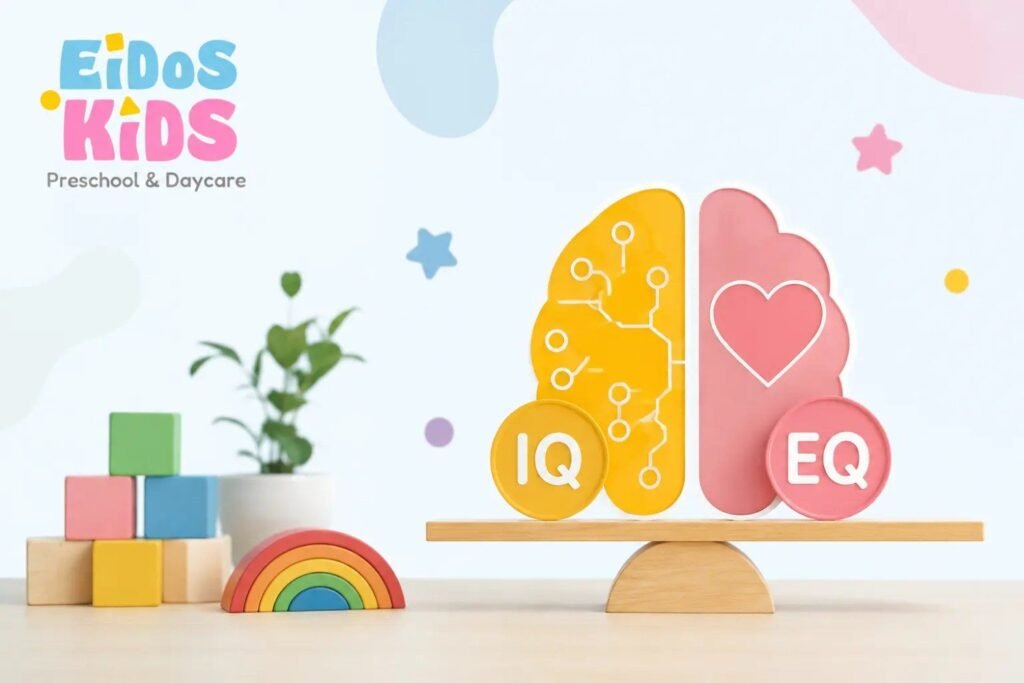
- Emotional intelligence preschool baner is a stronger predictor of life success than IQ across most domains
- The preschool years are the optimal window to build the foundations of EQ
- Children learn EQ through experience, not instruction – they need to feel, express and navigate emotions
- A school’s approach to tantrums and conflict reveals more about its EQ framework than any curriculum document
- EidosKids, co-founded by a Counselling Psychologist, builds EQ development into every aspect of the daily programme
| Metric | Data | Source |
| % of workplace success attributed to EQ vs IQ | EQ accounts for ~58% | Industry estimate |
| Children with strong EQ more likely to have positive school outcomes | Significantly more likely | PubMed |
| % of children who show poor self-regulation at school entry | ~25–30% | Industry estimate |
| Impact of preschool SEL curriculum on behaviour | 20–30% reduction in aggression | PubMed |
| % of preschool educators trained in SEL in India | Less than 30% | Industry estimate |
| Long-term outcomes for children in high-EQ preschool environments | Better relationships, higher life satisfaction | PubMed |
| % of Indian parents prioritising EQ over academic readiness | ~42% and growing | Industry estimate |
| QUICK FACTS |
- Emotional intelligence preschool baner predicts career success better than IQ in 90% of top performers (Industry estimate)
- Children who develop strong EQ by age 5 are less likely to struggle with mental health issues as adolescents
- Self-regulation – the ability to manage emotions and impulses – is the most important EQ skill for school readiness
- The prefrontal cortex (impulse control, reasoning) is not fully developed until age 25
- Young children feel emotions intensely and lack the biology to regulate them without adult support
- EQ is teachable – it develops through experience, practice and adult modelling
- Emotional Intelligence Development Statistics 2025-2026
The Five Components of Emotional Intelligence
EQ has five core components, each of which can be developed in the preschool years with the right environment and approach.
| EQ Component | What It Looks Like in a Preschooler | Why It Matters Later |
| Self-awareness | “I am angry because she took my toy” | Knowing your triggers, managing reactions |
| Self-regulation | Choosing how to express a feeling | Managing stress, staying focused under pressure |
| Motivation | Persisting through a difficult puzzle | Drive, resilience, work ethic |
| Empathy | Being concerned when a friend is upset | Relationships, leadership, collaboration |
| Social skills | Entering play, resolving conflict | Teamwork, communication, negotiation |
Children who develop these capacities in the preschool years enter school with a fundamentally different set of tools than those who have only developed academic knowledge.
How the Preschool Environment Shapes EQ
EQ cannot be taught in a lesson. It develops through experience – specifically, through experiencing emotions in a safe environment with responsive, regulated adults who model and support emotional competence.
When a preschool teacher responds to a child’s tantrum with calm curiosity rather than frustration or punishment, the child receives two simultaneous lessons: this emotion is manageable and adults can help. Repeated hundreds of times across the preschool years, this builds the neural pathways of self-regulation.
When a teacher facilitates a conflict between two children rather than simply resolving it for them, the children practise negotiation, perspective-taking and repair – the foundational social skills of adult life.
When a preschool uses isolation, punishment or shame as its primary behaviour management tool, children learn that emotions are dangerous and that the best strategy is to hide feelings. This is the opposite of EQ development.
What Good EQ Support Looks Like in Practice
| Practice | What It Looks Like | Why It Builds EQ |
| Naming emotions | “I can see you’re really frustrated right now” | Builds emotional vocabulary and self-awareness |
| Conflict facilitation | Teacher guides children to describe, feel, resolve | Develops negotiation and empathy |
| Welcoming big feelings | Child who cries met with empathy, not dismissal | Teaches emotions are safe to feel |
| Social problem-solving | Puppets and role-play explore difficult scenarios | Practice before real-life situations |
| Regulated environment | Quiet corners, sensory materials, clear routines | Supports co-regulation before self-regulation |
How EidosKids Builds EQ
At EidosKids, Emotional intelligence preschool baner development is embedded in the school’s design, relationships and daily practice. Co-founder Taiba Patel’s background in Counselling Psychology shapes how the school responds to every emotional experience a child has during the day. Teachers are coached in emotionally responsive practice.
The school’s zero-screen policy supports EQ development directly. Screens do not model empathy, do not respond to children’s emotional bids and do not provide the relational practice that builds social-emotional skills. Every hour at EidosKids is an hour of genuine human interaction.
Small group sizes ensure that every child’s emotional experiences are noticed and responded to immediately. A child in a class of 30 who is distressed at 11am may not be seen until 11.30. A child in a group of 12 with a trained educator is seen immediately.
Local Context: EQ and Baner Parents
Baner parents are, on average, highly achievement-oriented – for both themselves and their children. There is genuine and growing awareness among Baner families that the relentless academic focus of traditional Indian schooling has produced adults who are cognitively able but emotionally under-resourced: anxious, struggling with boundaries and poor at conflict resolution.
This awareness is one of the reasons demand for play-based, counselling-informed preschools has grown in Baner, Balewadi and Aundh. Parents want their children to do well academically – but more than that, they want them to be happy, resilient and capable of forming genuine relationships.
Frequently Asked Questions
Is EQ really more important than IQ for my child’s future?
For most outcomes that matter in life – career success, relationships, mental health, life satisfaction – EQ is a stronger predictor than IQ. IQ determines what you can do; EQ determines whether you can do it consistently with others.
Can EQ be taught, or is it something children are born with?
EQ has a genetic component but it is substantially shaped by experience, particularly in the first 6 years. The preschool environment and home environment are the two most influential EQ development contexts.
My child has frequent tantrums. Does that mean they have low EQ?
No. Tantrums are developmentally normal for children aged 2 to 4. They are the result of large emotions and an immature prefrontal cortex, not a character flaw or an EQ problem. How adults respond to tantrums shapes whether children develop healthy self-regulation over time.
How does EidosKids handle a child who is hitting or hurting other children?
The behaviour is addressed calmly and immediately, the child’s underlying feeling is acknowledged and the behaviour is redirected with support. Repeated patterns are discussed with parents in a private meeting. Punishment or public shaming is not used.
What can I do at home to support my child’s EQ?
Name emotions in daily life, allow your child to feel their feelings without rushing to fix them, model your own emotional regulation, read stories with emotionally complex characters and reduce screen time consistently.
At what age should children be expected to regulate their emotions without adult support?
Genuine independent self-regulation is not fully mature until the mid-20s. In preschool, the goal is co-regulation – children learning to manage emotions with adult support. Independent regulation is a later developmental achievement.
How does EidosKids track a child’s EQ development?
Teachers observe and document social-emotional development using structured frameworks. Progress across key EQ domains is discussed with parents in regular developmental meetings. There are no grades – only nuanced qualitative observations.
Conclusion
The evidence is clear: EQ shapes life outcomes more reliably than IQ. And the preschool years are when EQ foundations are built – or missed. A school that dismisses, shames or suppresses children’s emotional experiences is actively working against their future wellbeing.
EidosKids was built around this understanding. If you want a preschool in Baner that takes your child’s emotional life as seriously as their cognitive one, come and see what that looks like in practice.
DISCLAIMER
This article provides general information about emotional intelligence and child development. It does not constitute psychological advice. For concerns about your child’s social-emotional development, consult a qualified child psychologist or developmental paediatrician.