
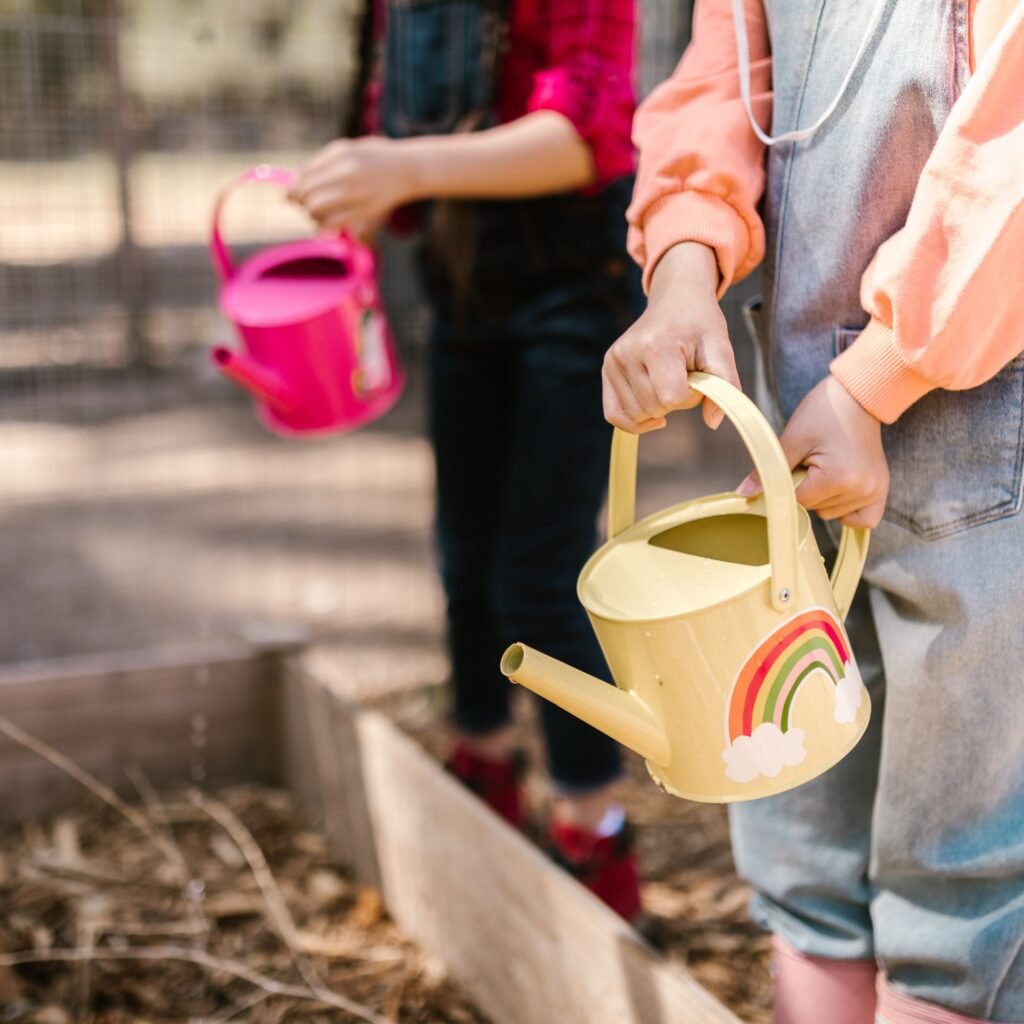
Ask a group of five-year-olds in Baner where tomatoes come from. You will likely hear ‘from the shop’ more often than ‘from a plant.’ That gap in understanding is not the child’s fault. It is a gap in experience. And it is one that a well-designed preschool can close with something surprisingly simple: getting children into the soil.
Farm-based learning at EidosKids PreSchool & DayCare gives children aged 2 to 6 direct, unhurried contact with seeds, soil and living plants as part of everyday school life. It is not an after-school club or a once-a-term outing. It is woven into the daily programme alongside language, numeracy and creative play because research is clear: the learning that happens in a garden is as rigorous as anything that happens at a desk.
Research from the Journal of Nutrition Education and Behaviour shows children who grow food at school are twice as likely to eat vegetables willingly compared to children with no gardening exposure.
Farm-based learning in early childhood gives children aged 2 to 6 direct contact with soil, seeds and growing food as part of their daily school experience. It builds scientific observation, responsible habits and healthy food choices. Research links regular gardening to stronger attention spans and greater willingness to eat vegetables in young children.
Farm-based learning in early childhood refers to structured learning experiences in which young children interact with plants, soil and growing food as part of their school curriculum. It includes planting seeds, watering plants, observing growth cycles, harvesting produce and learning about where food comes from.
The window between ages 2 and 6 matters more than people realise. Developmental researchers call it the sensitive period for nature connection. During this phase, first-hand engagement with the living world has a measurably higher impact on curiosity, ecological awareness and physical health than the same experiences introduced later. A child who grows a tomato at four carries a different relationship with food and the natural world into adulthood than one who never has.
At EidosKids PreSchool & DayCare, founded in Baner in 2024 by child development specialists, this is not treated as a nice extra. It is a direct consequence of taking developmental science seriously.
A lot more than gardening. Here is how the learning maps across subjects.
When a child presses a bean seed into soil and checks on it every morning, they are running a live experiment. They form expectations, observe what actually happens, notice causes and adjust. This is the scientific method at age four, practised through genuine curiosity rather than a textbook exercise. Children learn that living things have needs. They notice what sunlight does differently from shade. They watch a caterpillar on a leaf and ask questions no adult prompted.
How tall is the plant today compared to last week? How many seeds are in one pod? Which pot needs more water, the small one or the large one? The garden gives abstract numbers a physical purpose. For children aged 3 to 5, this kind of concrete interaction with quantity, measurement and comparison is far more developmentally appropriate than early pencil-and-paper work.
Children who garden talk more. They develop specific vocabulary: germinate, root, stem, harvest, compost. They tell stories about their plants to parents at pickup because they have something real to report. Research published in the Early Childhood Education Journal found that garden programmes significantly increase expressive vocabulary in preschool-aged children, with the strongest gains in children learning English alongside their home language.
A child who has watered a tomato plant for three weeks is not going to push it around their plate. Growing food changes the emotional relationship with it.
A review of 16 studies in Public Health Nutrition found consistent evidence that school gardening programmes increase fruit and vegetable intake in children aged 3 to 12. The explanation is straightforward: children eat food they feel connected to. The resistance to vegetables is usually about unfamiliarity and lack of control. Growing the food addresses both.
At EidosKids PreSchool & DayCare, fresh organic meals are prepared daily and children are involved in selecting and preparing what they have grown. For parents in Pune managing picky eaters, this is worth taking seriously. The solution is rarely pressure. It is ownership.
A garden is a shared space. Managing it together builds skills that a structured classroom activity can approximate but never fully replicate.
EidosKids PreSchool & DayCare was built by a team with professional backgrounds in child development psychology, architecture and education. The school’s approach to farming and outdoor learning reflects that foundation directly.
Every farming activity at EidosKids PreSchool & DayCare is matched to where the child is developmentally, not to what looks impressive at a parent open day.
| Nutrition Standards at EidosKids PreSchool & DayCare | What We Practice |
|---|---|
| 100% Organic Sourcing | All grains, pulses, dairy, fruits, vegetables and oils are strictly organic certified. No synthetic pesticides or chemical fertilisers enter our kitchen. |
| Zero Refined Sugar | We do not use white sugar, commercial syrups or artificial sweeteners. Natural sweetness is derived exclusively from whole fruits, dates or organic jaggery. |
| No Processed Ingredients | Packaged foods, commercial sauces, pre-mixes and preservatives are banned. Every meal, stock, puree and condiment is prepared from scratch daily. |
| Healthy Fats Only | Cooking relies solely on cold-pressed organic oils and A2 cow ghee. Refined oils, hydrogenated fats and trans-fats are never permitted. |
| Freshness Timeline | Meals are served within 45 minutes of preparation. We do not store leftovers, use frozen produce, or reheat food in microwaves. |
| Hydration Excellence | Only RO purified water stored in traditional clay pots is used for drinking and cooking – preserving mineral availability and traditional temperature management. |
This maps directly onto EidosKids PreSchool & DayCare five operating principles:
A farm-based learning session is not a designated period at the end of the day. It is integrated naturally into the morning flow.
Children arrive and check on their plants before anything else. Some water. Some record a measurement in their growth journal with a pencil and a ruler. One group is harvesting coriander that will appear in lunch. Another is turning compost with small tools.
The educator’s role is to observe, ask open questions and stay out of the way. ‘What do you think will happen if we move this one to the sunny spot?’ is more valuable than explaining what will happen.
After activity time, the language from the garden comes into circle time. Children talk about what they noticed, what surprised them and what they want to do tomorrow. The vocabulary is theirs. The curiosity is genuine.
No. Children in garden-based programmes consistently perform at least as well on language and science assessments as peers in traditional settings. The learning happens through the activity, not despite it.
This is very common in urban children. Patient, unpressured exposure over a few weeks usually resolves it. Forcing the issue makes it worse. EidosKids educators are trained in gentle, gradual introduction.
Yes. School visits are available by appointment. You can contact the team directly or view the gallery on the EidosKids website to see the current outdoor spaces.
Yes. Fresh organic meals are prepared daily and include produce that children have helped to grow and harvest.
Yes. NCERT’s Early Childhood Care and Education framework recommends nature-based and experiential learning for children below age 6 and explicitly supports gardening as developmentally appropriate practice.
Best Preschool & Daycare in Baner. Empowering kids through innovative, play-based holistic learning.