
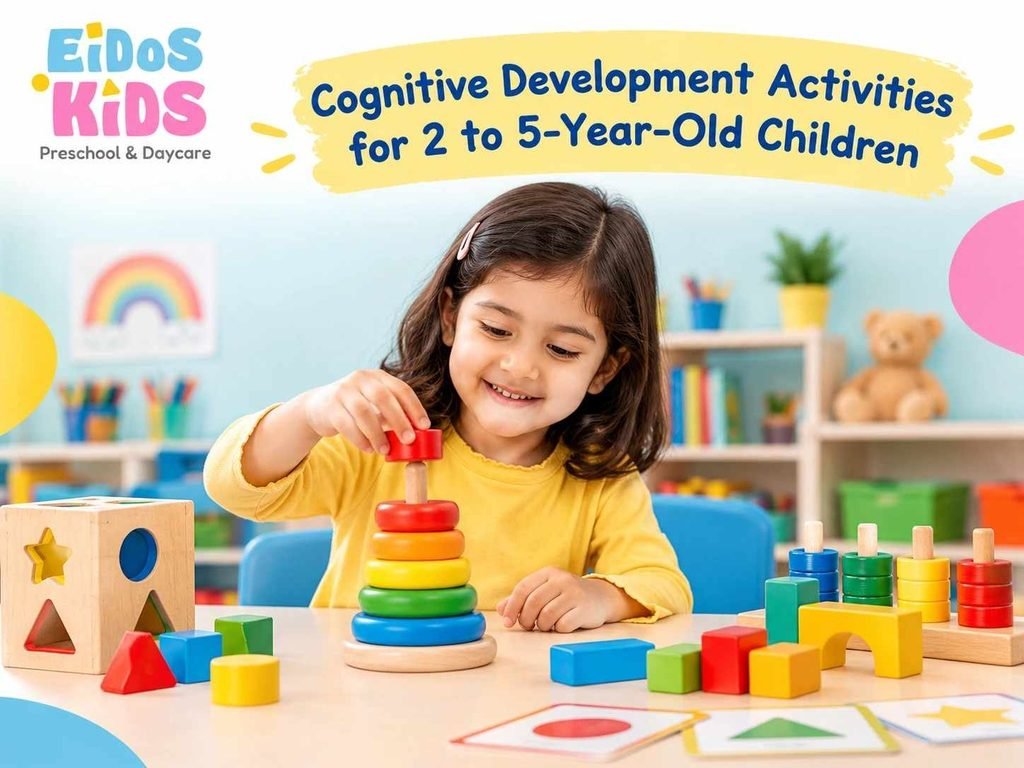
A two-year-old stacks three blocks and knocks them down with a grin. A four-year-old lines up toy cars by colour and announces that the red one is the fastest. Both children are doing serious thinking, even if it looks like plain play. If you are looking for cognitive development activities for toddlers that fit into an ordinary day at home, you don’t need flashcards or fancy kits. You need a little time, a few everyday objects and the patience to let your child work things out.
This guide explains what thinking skills look like between ages 2 and 5 and why play builds them. It then walks through activities for each stage, using things you already own.
What Does Cognitive Development Mean for a 2 to 5-Year-Old?
Cognitive development is the process by which a child learns to think, remember, solve problems and make sense of the world. It covers attention, memory, language, reasoning and imagination. These skills don’t arrive on a fixed date. They build slowly, one small win at a time.
The changes between ages 2 and 5 are big. A two-year-old learns mostly by touching, tasting and repeating. By three, children begin to pretend, so a wooden spoon turns into a phone. Four-year-olds ask “why” all day and start to sort, count and compare. Many five-year-olds can follow three-step instructions, hold a short story in memory and explain their reasoning, even when the logic is wonderfully creative.
Every child moves at a different pace. Treat the ages in this guide as rough signposts and not as deadlines. A child who talks late may be quick with puzzles. Another who counts to twenty may still find it hard to wait for a turn. Both fall within the range of healthy growth.
Why Do Cognitive Development Activities for Toddlers Matter?
Young children build thinking skills through experience, not explanation. When your child pours water from one cup into another, she learns about volume long before she hears the word. When you describe what she is doing, she attaches language to the idea.
The Harvard Center on the Developing Child calls this back-and-forth between a child and a caring adult serve and return. The child serves with a sound, a gesture or a question, and the adult returns it with attention and words. These small exchanges support brain development, language and social skills.
That is why the cognitive development activities for toddlers in this guide share one feature: they invite you to join in. A puzzle left on a shelf helps a little. A puzzle you solve together, with you asking “where might this piece go?”, helps far more.
Cognitive Development Activities for Toddlers Aged 2 to 3: Learning Through the Senses
At age 2, children learn by doing, so hands-on, short and repeated activities work well. Five to ten minutes is plenty. Follow your child’s interest rather than your own plan.
- Water and sand play. Fill a basin with water and add cups, spoons and a sieve. Let your child scoop, pour and watch what happens. This builds early ideas about full, empty, heavy and light. Say those words aloud as she plays.
- Shape posting. Cut a few holes in a shoebox lid and let your child push in blocks, bottle caps or large buttons. She works out which object fits which hole through trial and error, which is problem-solving in its simplest form.
- Hide and find. Cover a small toy with a cloth while your child watches, then ask where it went. Later, hide it while she looks away. This strengthens memory and the idea that things still exist when we can’t see them.
- Songs with actions. Rhymes such as “Wheels on the Bus” teach sequence and vocabulary. Pause before the last word and let your child fill the gap.
- Simple sorting. Hand over a bowl of mixed spoons and bottle caps and ask for the “same” things to go together. Don’t rush to correct mistakes. The thinking happens in the trying.
The First-Step Playgroup at EidosKids, for children aged 2 to 3, builds its day around this kind of exploration. Children handle mud, clay, sand and water, listen to repeated stories and sing rhymes during transitions, with no worksheets or screens involved.
Activities for Ages 3 to 4: Pretend Play and Early Problem-Solving
By age 3, children can hold more in memory, so pretend play and simple puzzles start to stretch their thinking. They also begin to grasp cause and effect: if I push this, that happens.
- Pretend play. Set up a kitchen, a clinic or a shop with cardboard boxes and old dupattas. When your child plays shopkeeper, he practises planning, turn-taking and language all at once.
- Simple puzzles. Move from knob puzzles to four-piece and then eight-piece jigsaws. Ask “which piece has the blue sky?” so he learns to look for clues instead of guessing.
- Colour and shape hunts. Walk around the house and ask him to find three round things or something yellow. This trains attention and sorting.
- Story retelling. After a bedtime story, ask what happened first and what came next. Accuracy isn’t the goal. You are building memory and a sense of order.
- Threading and pouring. Large beads on a shoelace, or dal poured from a jug into a bowl, strengthen small hand muscles and focus together.
The Nursery programme for children aged 3 to 4 pairs clay, threading, painting and pouring with daily outdoor play, because hand skills and thinking skills grow side by side.
Activities for Ages 4 to 5: Planning, Patterns and Reasoning
Four and five-year-olds can plan a few steps ahead and explain their thinking, so give them tasks with more than one step.
- Board and card games. Snakes and ladders, memory match and dominoes teach counting, rules and patience. Losing gracefully is a thinking skill too.
- Building challenges. Ask your child to build a bridge a toy car can cross or a tower taller than her teddy. Let it fall. Then ask what she could change.
- Kitchen maths. Let her count the rotis, match lids to pots or measure rice with a cup. Real tasks feel more interesting than worksheets.
- Patterns. Lay out leaves, stones or beads in a big, small, big, small sequence and ask what comes next. Patterns are the groundwork for early maths.
- “What if” experiments. Ask “what will happen if we leave this ice in the sun?” and then check together. Predicting and testing is the first step towards scientific thinking.
In the Junior KG classroom, children aged 4 to 5 take this further through multi-day projects, such as a boat-floating investigation at the water table, where they ask questions, test ideas and present what they found.
How Can Everyday Routines Build Thinking Skills?
Not every activity needs a setup. Routine moments are the easiest cognitive development activities for toddlers to fit in, because they need no preparation and no extra time. Your child is already eating, shopping, bathing and travelling, so the learning is waiting inside those moments.
- Mealtimes. Ask your child to put one katori at each place or guess which food is still hot.
- Market trips. Let her find three red vegetables or tell you which bag is heavier.
- Bath time. Floating and sinking toys teach early science with no extra effort.
- Travel. Play “I spy”, or ask what your child can hear with her eyes closed.
Open-ended questions work better than yes-or-no ones. “What do you think will happen next?” gives your child room to think, while “Is this a circle?” ends the conversation in one word.
How Much Screen Time Is Reasonable for Young Children?
The World Health Organization advises no more than one hour of sedentary screen time a day for children aged 2 to 4 and adds that less is better. It also recommends at least 180 minutes of physical activity spread across the day. Running, climbing and jumping aren’t a break from learning. They are part of it, because the body and brain develop together. Swapping some screen minutes for cognitive development activities for toddlers, such as sorting or pouring, also gives your child’s attention something active to work on.
If your child loses a skill they once had, or a worry about their development stays with you, speak to your paediatrician. An early check doesn’t label a child. It simply opens the door to support when it’s needed.
Conclusion: Small Daily Moments Build Thinking Skills
Cognitive development activities for toddlers don’t need to be elaborate. A basin of water, a shoebox, a handful of leaves and your full attention will do more than any gadget. Pick one or two ideas from this guide, repeat them often and let your child lead.
If you would like your child to get this kind of guided play every day, EidosKids offers play-based programmes for children aged 2 to 12, from Playgroup and Nursery to Junior KG, Senior KG and DayCare. Here is what families get:
- Play-based learning. Sensory play, outdoor play and project work replace worksheets and screens.
- Individual tracking. Each child’s development is observed on its own terms instead of against one common yardstick.
- Daily parent updates. Parents hear what their child did, along with workshops and family events.
- Fresh organic meals. Meals and snacks are prepared daily, under one all-inclusive fee with no hidden charges.
The school is led by two co-founders. Taiba Patel is a counselling psychologist with nine years of experience in Canada, and her focus areas are early intervention, individual attention and parent guidance. Smita Patil is an architect and educator with a Master’s degree in Environmental Architecture and more than ten years of academic and teaching experience. She designed the school’s spaces around sensory, indoor and outdoor play. You can read more about the school’s founders before you visit.
If you would like to see the classrooms and talk to the team, contact EidosKids to plan a campus visit.
Frequently Asked Questions
What are cognitive development activities for toddlers?
They are simple play-based tasks that help a child practise thinking, memory, attention and problem-solving. Examples include sorting objects, water play, hide and find games, puzzles and pretend play. At this age, the adult’s role is to join in, name what the child is doing and ask gentle questions.
How can I improve my 2-year-old’s cognitive skills at home?
Offer short, hands-on activities such as pouring water, posting shapes into a box or singing rhymes with actions. Talk about what your child is doing in simple words and repeat favourite games often. Repetition helps a two-year-old build memory and confidence.
How long should cognitive activities last for a 3-year-old?
Ten to fifteen minutes works for most three-year-olds, and some will lose interest sooner. Stop when your child does. Several short sessions through the day suit a young child better than one long sitting, and you can return to the same activity the next day.
Do cognitive development activities for toddlers need special toys?
No. Cups, spoons, boxes, leaves, bottle caps and kitchen items do the job well, and they cost almost nothing. Open-ended objects that can be used in many ways often keep children thinking longer than toys that do one thing.
Is play-based learning enough for children under five?
Yes, for most children. Cognitive development activities for toddlers and preschoolers work because they feel like play. Through play they practise language, number sense, planning and social skills without pressure. Formal reading and writing can wait until children are older and ready.
When should I speak to a doctor about my child’s thinking skills?
Speak to your paediatrician if your child loses a skill they once had or if a concern about their learning, speech or play stays with you. A developmental check is simple, and early support makes it easier for the child to move ahead.