KEY TAKEAWAYS
- Preschool activities Baner Pune Ganesh Chaturthi is Maharashtra’s most celebrated festival and one of the richest cultural learning opportunities for preschoolers
- Age-appropriate celebration involves hands-on activity, story and sensory experience – not passive observation
- Eco-friendly Ganesh-making from clay teaches children environmental values alongside cultural ones
- EidosKids integrates festival learning into its broader cultural identity curriculum across the full year
- Even children from non-Hindu backgrounds can participate meaningfully in the cultural and communal aspects of the festival
| Metric | Data | Source |
| Ganesh Chaturthi duration (standard celebration) | 10 days | Cultural record |
| % of Maharashtra households celebrating Ganesh Chaturthi | Over 80% | Industry estimate |
| Fine motor benefits of clay modelling for preschoolers | Significant, well documented | PubMed |
| Children’s cultural identity formation peak | Ages 3–6 | NCERT |
| Environmental impact of PoP vs clay Ganesha idols | PoP releases 50x more toxins | Industry estimate |
| % of Baner families celebrating Ganesh Chaturthi at home | ~65% | Industry estimate |
| Preschools in Baner with structured Ganesh Chaturthi programmes | Less than 50% | Industry estimate |
QUICK FACTS
- Ganesh Chaturthi marks the birth of Lord Ganesha and is celebrated across Maharashtra with great devotion
- The Pune Ganesh festival, established by Lokmanya Bal Gangadhar Tilak in 1893, is one of the oldest public celebrations in India
- Eco-friendly Ganesha idols made from natural clay are the traditional and most environmentally responsible choice
- Making clay figurines develops fine motor skills, creativity and sensory processing simultaneously
- Children as young as 2 can participate meaningfully in age-appropriate Ganesh Chaturthi activities
- Shared festival experiences build community belonging and cultural identity in young children
- Ganesh Chaturthi Preschool Activities Statistics 2025-2026
Why Festival Learning Matters at Preschool
Young children learn from experience, not explanation. Telling a 4-year-old about the victory of light over darkness is abstract and mostly meaningless. Letting them hold a clay Ganesha they made themselves, telling the story while they work and eating modak together is a memory they carry for life.
| Festival Element | Developmental Domain It Builds | How EidosKids Delivers It |
| Clay modelling | Fine motor, sensory processing, creativity | Multi-session clay Ganesha making |
| Marigold threading | Fine motor, bilateral coordination, patience | Pre-festival decoration sessions |
| Story of Ganesha | Language, comprehension, cultural identity | Puppet storytelling, picture books |
| Modak making | Sensory, following instructions, culture | Hands-on food preparation |
| Classroom decoration | Creative expression, community pride | Child-made artwork throughout |
The EidosKids Ganesh Chaturthi Programme
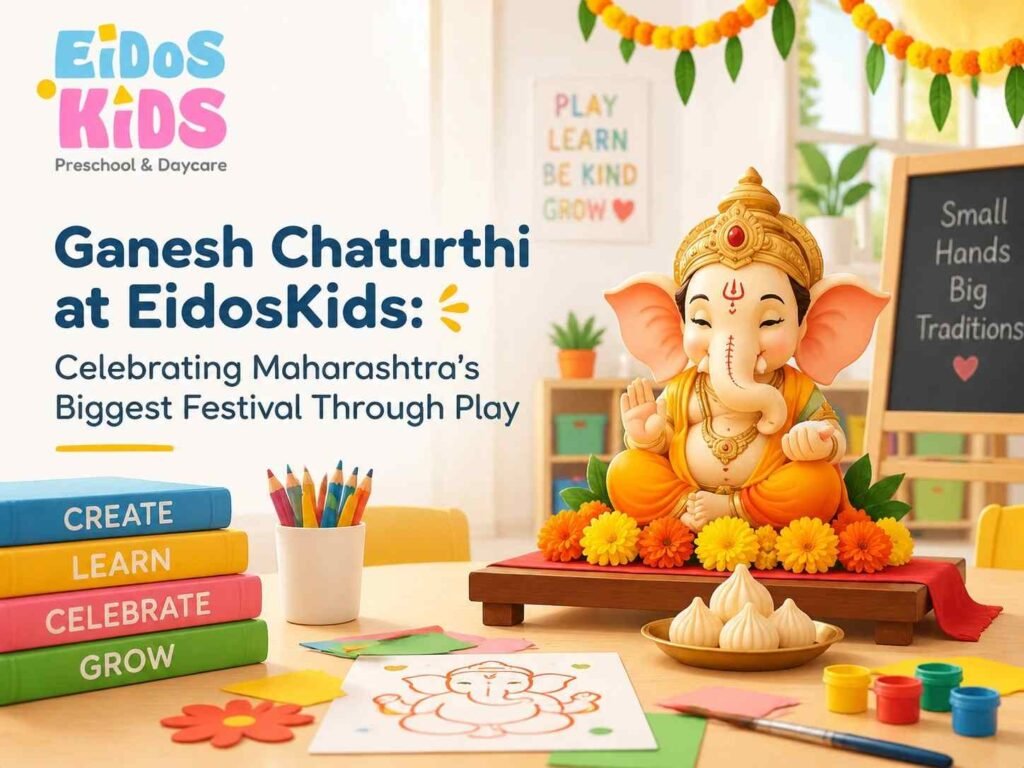
Eco-Ganesha Clay Modelling
Over two or three sessions in the weeks before Ganesh Chaturthi, children work with natural clay to make their own simple Ganesha figures. For the youngest children in Playgroup and Nursery, this is primarily a sensory experience – rolling, pressing, shaping. For older children in Junior and Senior KG, it becomes a more intentional creative activity with greater control and detail.
The developmental benefits are significant: fine motor coordination, bilateral hand use, problem-solving and creative expression. The environmental lesson is woven in naturally – clay idols do not harm water bodies when immersed. This is a conversation even a 4-year-old can understand and retain.
Marigold and Flower Threading
Threading marigolds and leaves is a traditional part of festival decoration – and an outstanding fine motor activity. Children develop pincer grip, hand-eye coordination and sustained attention while making something beautiful that is directly used in the classroom decoration.
The Story of Ganesha
Co-founder Taiba Patel’s psychology background ensures that stories told at EidosKids are adapted to the developmental stage of the children hearing them. For 3 to 4-year-olds, Ganesha’s story becomes a narrative about a clever, kind character who solves problems. For 5 and 6-year-olds, more mythological depth can be introduced.
Modak Making
Making modak – Ganesha’s favourite sweet – is one of the most beloved food activities of the festival. Children participate in age-appropriate food preparation: mixing, shaping or rolling dough, filling with coconut and jaggery. The freshly made modak is eaten together.
Inclusivity in Festival Celebrations
EidosKids‘ classroom is diverse. Not all children are from Hindu or Maharashtrian families. The school’s approach to Ganesh Chaturthi – as with all festival celebrations – is cultural and communal rather than strictly religious.
Children from all backgrounds are invited to participate in the craft, the story, the food and the joy of the festival. No child is required to participate in any ritual. The emphasis is on sharing a cultural tradition that belongs to the community the school is part of – Baner, Pune, Maharashtra.
Local Context: Ganesh Chaturthi in Baner
Baner and the wider Pune-Pimpri-Chinchwad area take Ganesh Chaturthi seriously. The neighbourhood Ganesh mandals, the processions and the distinctive dhol-tasha sounds that fill the streets – for children growing up in Baner, this is one of the most formative cultural experiences of their childhood.
A preschool that celebrates Ganesh Chaturthi meaningfully is not only doing good curriculum work – it is connecting children to the world outside the classroom in a way that matters to their families and community. The preschool activities at EidosKids Baner Pune during Ganesh Chaturthi season are a concrete example of this connection.
Frequently Asked Questions
How does EidosKids include children from non-Hindu backgrounds in Ganesh Chaturthi celebrations?
Activities focus on the cultural, creative and communal dimensions of the festival – clay craft, storytelling, food and decoration – rather than religious ritual. All children are welcome to participate and none are required to.
Why clay and not PoP (Plaster of Paris) for Ganesha making at preschool?
Clay is natural, safe for children to handle, biodegradable and teaches environmental values. PoP is a chemical compound that can irritate young children’s skin and is harmful to water bodies. Clay is the only appropriate material for preschool use.
Do children get to bring their Ganesha creation home?
Yes. Children take home their clay creations. Parents are encouraged to explain the immersion tradition and to immerse the clay Ganesha in a bucket of water rather than a public water body.
What age groups participate in Ganesh Chaturthi activities at EidosKids?
All age groups – Playgroup through Senior KG – participate in age-appropriate versions of the activities. Complexity increases with age, but all children are included.
Does EidosKids celebrate other Maharashtra festivals with similar depth?
Yes. The school’s cultural calendar includes Diwali, Holi, Gudi Padwa and other festivals that are meaningful to the community the school serves.
Can parents participate in Ganesh Chaturthi activities at EidosKids?
EidosKids welcomes parent involvement in special events. Contact the school at the start of the year to understand the events calendar and parent participation arrangements.
Does the Ganesh Chaturthi programme affect the regular curriculum?
Festival activities are integrated into the regular daily programme rather than replacing it. Developmental goals are maintained – festival activities simply become the vehicle for delivering them during the festival period.
Conclusion
Ganesh Chaturthi is one of the great gifts of growing up in Pune. A preschool that celebrates it with intention – through clay, story, food and community – gives children something they carry for life: a felt sense of belonging to something larger than themselves.
At EidosKids, festivals are part of the curriculum, designed to develop cultural identity, creativity and community connection in ways that serve children long after the dhol-tasha has moved on.
DISCLAIMER
This article describes general approaches to festival education in preschool settings. EidosKids’ specific programme activities may vary each year. Contact the school for current programme details.