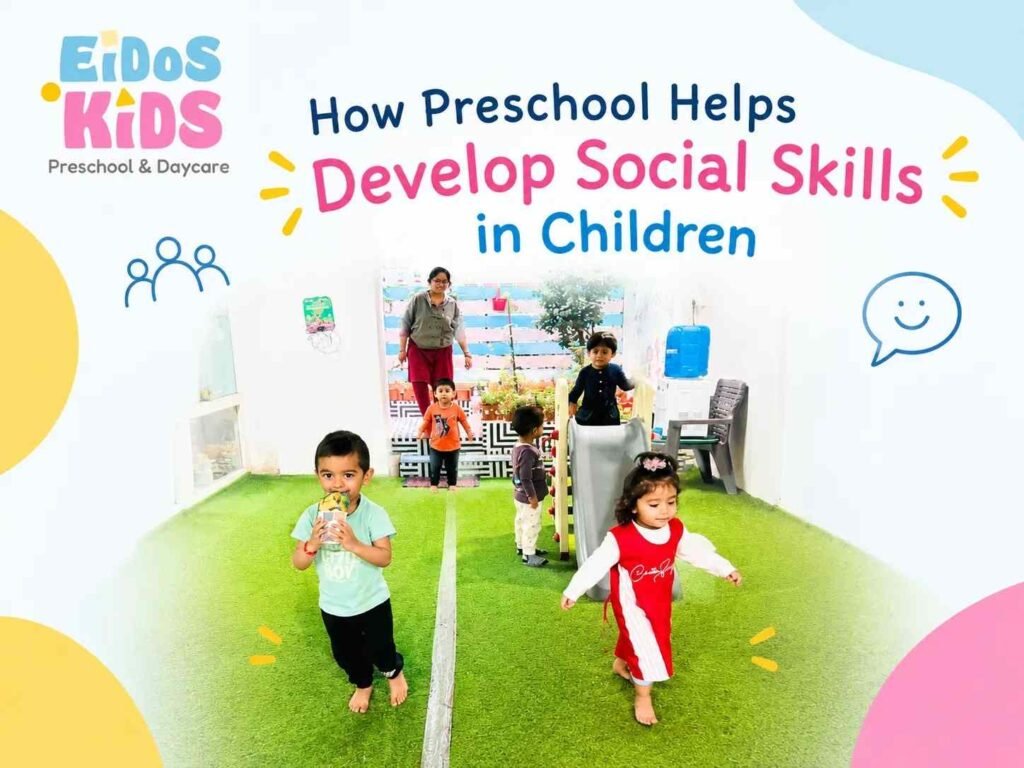
Most parents think about ABCs and counting when they picture preschool. But ask any early childhood educator, and they will tell you the real work happening in those classrooms has little to do with worksheets. How preschool helps develop social skills in children is one of the most important, and least talked about, benefits of early education. Long before a child learns to read fluently, preschool teaches them how to share a toy, wait their turn, resolve a small fight, and work alongside other children they did not choose to sit next to. These are skills no textbook can teach in isolation. They need daily practice with real people, and that is exactly what a good preschool classroom provides.
What Do We Mean by “Social Skills” in Early Childhood?
Social skills are the everyday abilities children use to interact, cooperate and communicate with people around them. This includes speaking up, listening, reading facial expressions, managing frustration and understanding that other people have feelings too.
A child with strong social skills is not simply “well behaved.” They are able to negotiate, express disagreement without hitting or shouting, and rebuild a friendship after a small conflict. These abilities form the foundation for how a child will handle relationships, teamwork and even classroom learning for years to come.
How Preschool Helps Develop Social Skills in Children
Preschool works as a structured social laboratory. Children are placed in a room with peers their own age, given shared materials, and guided by teachers who model appropriate responses in real time. This combination of exposure, repetition and gentle correction is what builds lasting social ability. Here is how it plays out across a typical preschool day.
Learning to Share and Take Turns
At home, a child often has undivided attention and their own toys. In preschool, that changes on day one. There are only so many building blocks, only one swing, and one teacher’s attention split across fifteen children. This forces children to practice sharing, waiting and taking turns, often for the first time in their lives.
Teachers use simple tools like turn-taking charts, timers and paired activities to make this process less stressful. Over weeks, most children move from grabbing and crying to asking “can I have a turn after you” without adult prompting.
Building Communication and Listening Skills
Preschool classrooms run on talking and listening. Circle time, group instructions and pretend play all require a child to express what they want clearly and to listen when someone else is speaking. Children who struggle to communicate quickly discover that using words gets them what they need faster than pointing or crying.
Group storytelling, show and tell, and simple question and answer routines also help children build vocabulary they can use to describe feelings such as “I am upset” or “I am excited,” which reduces frustration-driven behaviour.
Understanding Emotions and Empathy
Young children are naturally self-focused, and that is developmentally normal. Preschool is often the first place a child sees a peer cry, get hurt or feel left out, and is guided to respond to it. Teachers narrate these moments out loud, saying things like “Riya is sad because her tower fell, what can we do to help her,” which teaches children to notice and respond to another person’s emotional state.
This repeated exposure to other children’s feelings, paired with adult guidance, is how empathy starts to form. It rarely develops from being told to be kind. It develops from practicing kindness in real situations.
Practicing Conflict Resolution
Two children want the same toy at the same time, several times a day, in every preschool classroom in the world. Rather than solving the conflict for the children, good preschool teachers walk them through it, asking each child what happened and helping them agree on a fair solution such as taking turns or trading toys.
Over time, children start applying these steps on their own. This early, low-stakes conflict resolution practice, built through a genuinely play-based learning environment, is one of the strongest predictors of how well a child manages disagreements later in school and in adult relationships.
Working as Part of a Group
Group projects such as building a shared structure, acting out a story or completing a nature activity together teach children that their actions affect the whole group. A child learns that hoarding materials slows everyone down, and that dividing tasks gets the job done faster. This is the earliest form of teamwork a child will ever practice, and it sets the pattern for how they collaborate in later school years.
What Social Skills Should a Child Learn Before Class 1?
By the time a child moves from Senior KG into Class 1, most preschools aim for the following social milestones:
- Sharing and turn-taking without adult reminders in most situations
- Following group instructions given to a full class rather than one on one
- Expressing needs verbally instead of through crying or physical reactions
- Recognising basic emotions in themselves and in classmates
- Resolving minor disagreements with peers using words first
- Working within a small group on a shared task for a short period
Children develop these at different paces, and a strong preschool programme adjusts its approach based on where each child actually is, rather than pushing every child through the same timeline.
How Can Parents Support Social Skill Development at Home?
Preschool does the heavy lifting, but parents can reinforce these skills between school hours with a few simple habits.
- Arrange short playdates with one or two children rather than large groups, which are easier for younger children to manage
- Narrate emotions during daily life, such as saying “you seem frustrated because your tower fell,” so children build emotional vocabulary
- Avoid solving every conflict immediately. Let your child attempt to resolve small disagreements with siblings or friends before stepping in
- Read stories about friendship and feelings and pause to ask what a character might be feeling
- Praise specific social behaviour, for example “I liked how you waited for your turn,” rather than generic praise like “good job”
- Limit solo screen time in favour of activities that involve another person, since social skills only grow through actual interaction
What Are Common Signs of Strong Social Development in Preschoolers?
Parents often ask how to know if their child is on track socially. A few common markers include:
- The child can play alongside or with other children for extended periods without adult intervention
- They can name at least a few basic emotions in themselves and others
- They attempt to resolve small conflicts with words before reacting physically
- They show interest in helping a peer who is upset or struggling
- They can follow group instructions given to the whole class, not just one on one
A child who is still developing in these areas is not falling behind. Social growth is uneven and highly individual, and a good preschool programme accounts for that rather than expecting uniform progress.
Frequently Asked Questions
Q1: At what age should a child start preschool for social skill development?
Most children benefit from starting between the ages of two and three, when they begin showing genuine interest in playing near or with other children. Starting earlier is not necessary, but starting later can mean a child has fewer years to practice these skills before Class 1.
Q2: Can a shy or introverted child still develop strong social skills in preschool?
Yes. Shy children often need more observation time before joining group play, and a good preschool teacher adjusts pace and support for each child rather than pushing everyone into the same routine at the same speed.
Q3: Does daycare offer the same social benefits as a half-day preschool programme?
A well-structured full-day daycare setting can offer even more social practice simply because children spend more hours interacting with peers, provided the daycare includes guided group activities rather than only supervised free time.
Q4: What if my child still struggles with sharing after months in preschool?
This is common and usually improves with continued, consistent practice. Teachers typically use small group activities and gentle redirection rather than punishment, since sharing is a skill built through repetition, not a switch that flips overnight.
Q5: How is social skill development tracked at a preschool?
Most quality preschools observe children during free play, group activities and transitions, then share these observations with parents through regular updates rather than only formal report cards, since social growth shows up in daily behaviour more than in tests.
Conclusion
How preschool helps develop social skills in children ultimately comes down to daily, repeated practice with real peers under the guidance of trained educators, something no amount of screen time or solo play at home can replicate. Sharing, communication, empathy, conflict resolution and teamwork are not taught through a single lesson. They are built gradually, through hundreds of small interactions across a school year.
At a preschool built around a genuine holistic early education approach, this social development is treated as seriously as pre-literacy or motor skills, with trained early childhood educators observing each child’s social pace and adjusting group activities accordingly. The result is a child who enters Class 1 not just knowing letters and numbers, but knowing how to make a friend, handle a disagreement and work as part of a group, skills that carry far beyond the classroom.