Table of Contents
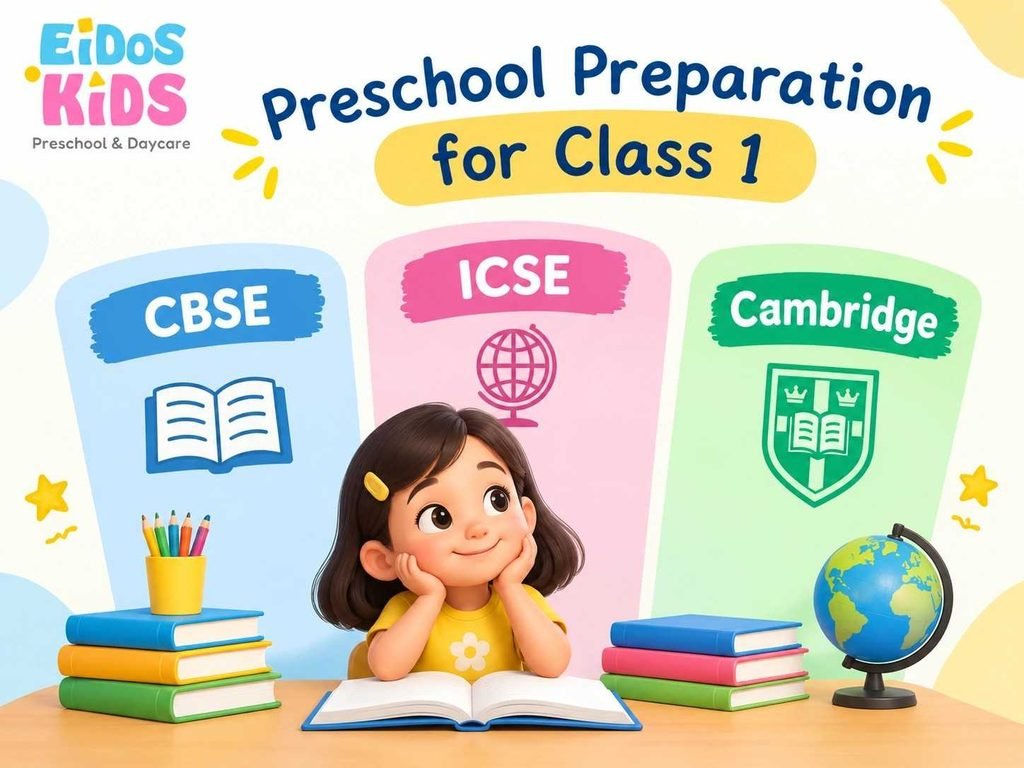
Choosing a preschool for CBSE ICSE Cambridge Pune families is rarely a simple tick-box exercise. Parents in Pune today are not just picking a place where their three or four year old will spend a few hours a day. They are quietly laying the groundwork for a school transition that happens two or three years later, and the board that the family eventually chooses for primary school changes what “ready for Class 1” actually means.
A child moving into a CBSE school needs a different readiness profile compared with one heading into an ICSE school or a Cambridge curriculum programme. A good preschool plans for that difference from the Playgroup and Nursery years onward.
This piece walks through what each board expects from an incoming Class 1 student, how the three systems differ in structure and skill emphasis, and what a Pune parent should actually look for in a preschool programme once they have a board in mind, or even if they have not decided yet. It also covers the broader readiness markers that admission teams tend to watch for, independent of which board a family eventually settles on.
Why Pune Parents Are Weighing All Three Boards Together
A decade ago, most Pune families picked a board early and stayed within that ecosystem through school admissions. That pattern has loosened. Rising interest in international schooling, more Cambridge-affiliated schools opening across the city, and parents relocating for work mean many families now keep two or three boards on the shortlist well into the preschool years. This shift changes what preschools are expected to deliver. A programme that only teaches toward one board’s Class 1 entry test can leave a family scrambling if their final school choice changes. A programme built on transferable readiness skills, instead, keeps every option open for longer.
What CBSE Expects From a Class 1 Entrant
CBSE, the Central Board of Secondary Education, is the most widely followed board across Pune’s primary schools. Its Class 1 classroom usually moves at a fairly structured academic pace from day one, with early emphasis on Hindi and English literacy alongside number work. A child coming from a CBSE-aligned preschool pathway generally needs:
- Letter and sound recognition in at least one language, ideally two, since bilingual literacy starts early
- Number sense up to 20 or more, including simple addition concepts through counting and grouping
- Classroom stamina, meaning the ability to sit through a structured lesson block without constant redirection
- Fine motor control for pencil grip and early writing, since CBSE schools introduce writing tasks quickly
CBSE schools tend to follow NCERT textbooks closely, so the pace in Class 1 can feel brisk compared with play-based preschool years. This is one reason many Pune parents ask preschools directly how they bridge that gap.
What ICSE Expects From a Class 1 Entrant
ICSE, administered by the Council for the Indian School Certificate Examinations (CISCE), is often chosen by parents who want stronger early emphasis on English language skills and a broader, more detailed curriculum later in school. Class 1 classrooms under ICSE schools typically expect:
- Strong English vocabulary and comprehension readiness, since ICSE places heavy early weight on English
- Early exposure to structured grammar concepts, even in a light, oral form before Class 1 begins
- Project and activity familiarity, since ICSE schools often introduce simple project work earlier than CBSE schools
- Listening and narration skills, because ICSE classrooms frequently use storytelling and discussion as teaching tools
Children moving into ICSE schools benefit from a preschool background that treats language as something to explore in depth rather than just decode, with regular read-aloud sessions and vocabulary-building play.
What Cambridge Expects From a Class 1 Entrant
The Cambridge curriculum, run through Cambridge International, is less common across Pune but growing, particularly among parents planning for an eventual international move or an IB-aligned secondary pathway. Cambridge Primary, which begins at what Indian schools call Class 1, is built around inquiry and skill application rather than textbook sequencing. A child entering this system usually needs:
- Comfort with open-ended questions, since Cambridge classrooms reward reasoning over memorised answers
- Early collaborative skills, as group tasks and peer discussion start from the first term
- Basic digital and visual literacy, since Cambridge Primary often blends print material with interactive resources
- Self-directed task completion, meaning a child who can start and finish a short activity with limited adult prompting
Cambridge schools assess progress continuously rather than through single high-stakes exams at this stage, so the readiness bar is less about rote content and more about how a child approaches a new problem.
CBSE vs ICSE vs Cambridge: The Core Differences
Rather than laying this out as a side-by-side table, it helps to separate the three systems by what they actually prioritise in the early years.
- Pace and structure: CBSE moves fastest into formal content, ICSE builds language depth before pace, and Cambridge spreads skill-building across inquiry-based tasks rather than a fixed sequence
- Language emphasis: ICSE leans hardest into English from day one, CBSE balances Hindi and English together, and Cambridge is taught entirely in English with strong oracy expectations
- Assessment style: CBSE and ICSE both move toward periodic written assessment fairly early, while Cambridge relies more on ongoing teacher observation and skill checkpoints
- Skill focus: CBSE rewards accuracy and recall, ICSE rewards expression and detail, and Cambridge rewards reasoning and collaboration
None of this means one board produces a better outcome than another. It means the preparation a child needs before Class 1 looks different depending on which system the family is aiming for, and a preschool that understands all three can adjust its own classroom focus accordingly. A parent comparing prospectuses across schools will usually find these differences described in very similar language once they know what to look for.
How a Good Preschool Builds Class 1 Readiness Across All Three Boards
A well-run preschool does not need to pick a single board and teach toward it exclusively. Most children in Pune’s preschool years have not had their final school confirmed, and many families only firm up the decision closer to admissions season. The stronger approach is a preschool programme built on core developmental readiness that transfers cleanly into any of the three systems:
- Executive function first, since every board’s Class 1 classroom depends on a child’s ability to follow multi-step instructions and manage transitions between activities
- Literacy through meaning rather than drilling, which supports CBSE’s early writing demands, ICSE’s vocabulary depth and Cambridge’s inquiry style equally well
- Numeracy through hands-on investigation, building the number sense that both CBSE and ICSE test directly and that Cambridge expects children to apply in open tasks
- Social and emotional regulation, which matters just as much in a structured CBSE classroom as in a collaborative Cambridge one
A preschool’s Senior KG programme is usually where this readiness work becomes most visible, since the final year before Class 1 is when beginning reading, numeracy and classroom behaviour come together under direct observation. Before that, the Junior KG curriculum lays the groundwork through extended project work and early pre-literacy exposure, so the final year is building on an established base rather than starting cold.
Signs a Child Is Genuinely Ready for Class 1, Whatever the Board
Beyond board-specific checklists, most primary school admission teams in Pune, regardless of curriculum, look for a similar underlying picture of readiness. A preschool tracking the right things in Senior KG usually watches for:
- Independent task completion, such as finishing a worksheet or craft activity without step-by-step adult guidance
- Comfortable separation and settling, meaning the child transitions into a new classroom or teacher without prolonged distress
- Basic self-care, including managing a lunch box, washroom routine and classroom materials independently
- Willingness to attempt new tasks, even ones the child finds difficult, without immediately giving up or seeking rescue
- Peer interaction without constant adult mediation, since Class 1 classrooms expect children to resolve small social moments on their own
These markers matter more than any single academic milestone, because a child who is socially and behaviourally ready adapts faster to a new board’s academic pace than one who is academically advanced but not yet independent.
Choosing a Preschool for CBSE ICSE Cambridge Pune Families
For parents who already have a preferred board in mind, a few practical questions narrow the search considerably. Ask the preschool how they introduce early literacy and whether that approach leans toward phonics-heavy instruction, which tends to suit CBSE and ICSE pathways, or toward broader language exposure, which fits Cambridge expectations better. Ask how structured a typical day looks, since a classroom with long blocks of guided seat work prepares differently than one built around open stations and choice time.
It also helps to ask directly how the preschool handles children whose board has not been finalised yet. A preschool for CBSE ICSE Cambridge Pune families should be comfortable explaining how its daily structure supports more than one pathway, rather than defaulting to a single board’s style and hoping it transfers. Pune parents comparing options may find it useful to read through a broader preschool selection guide, which covers the wider evaluation criteria beyond board readiness alone, and a related piece on the right age for preschool for families still deciding when to start.
For official curriculum details straight from the source, the CBSE academic portal and the Cambridge Primary curriculum page are both useful references when comparing syllabus structure directly.
Conclusion
Preparing a child for Class 1, whichever board a family eventually chooses, comes down to steady developmental groundwork rather than last-minute drilling. EidosKids, a preschool for CBSE ICSE Cambridge Pune families based in Baner, builds its Playgroup through Senior KG programmes around exactly this kind of groundwork: executive function, language through meaningful exposure, hands-on numeracy and emotional regulation, all of which carry over cleanly whether a child is headed into a CBSE, ICSE or Cambridge classroom. The teaching team works from a developmental-psychology-informed curriculum rather than a one-size approach, and the Senior KG year is specifically structured around the cognitive, social, academic and physical readiness markers that most primary schools look for at admission. Parents who want to see this in practice, or who are still weighing which board fits their child, are welcome to book a campus visit and walk through a classroom in session.
Frequently Asked Questions
Does my child need to know which board they are joining before starting preschool?
No. Most preschool readiness skills, such as early literacy, numeracy and classroom behaviour, transfer across CBSE, ICSE and Cambridge classrooms. Families can finalise the board closer to Class 1 admissions.
Is Cambridge curriculum harder for a young child than CBSE or ICSE?
It is not harder, just different in emphasis. Cambridge Primary focuses more on reasoning and collaborative tasks, while CBSE and ICSE introduce structured literacy and numeracy content earlier.
Which board suits a child who struggles with long seated activities?
A child who needs movement and variety during learning time may settle more easily into a Cambridge-style classroom, though this varies by individual school and should be discussed with the preschool’s teaching staff directly.
How early should preschool readiness planning for Class 1 begin?
Ideally from the Junior KG year, since executive function, early literacy exposure and numeracy foundations build gradually and are difficult to compress into a single final term.
Does ICSE really require stronger English skills at entry than CBSE?
ICSE places heavier early emphasis on English vocabulary and comprehension compared with CBSE’s more balanced Hindi-English approach, though both boards expect solid early literacy.
Can a preschool prepare a child for more than one board at the same time?
Yes. A preschool built around core developmental skills rather than board-specific drilling can support readiness for CBSE, ICSE or Cambridge pathways without committing early to one system.