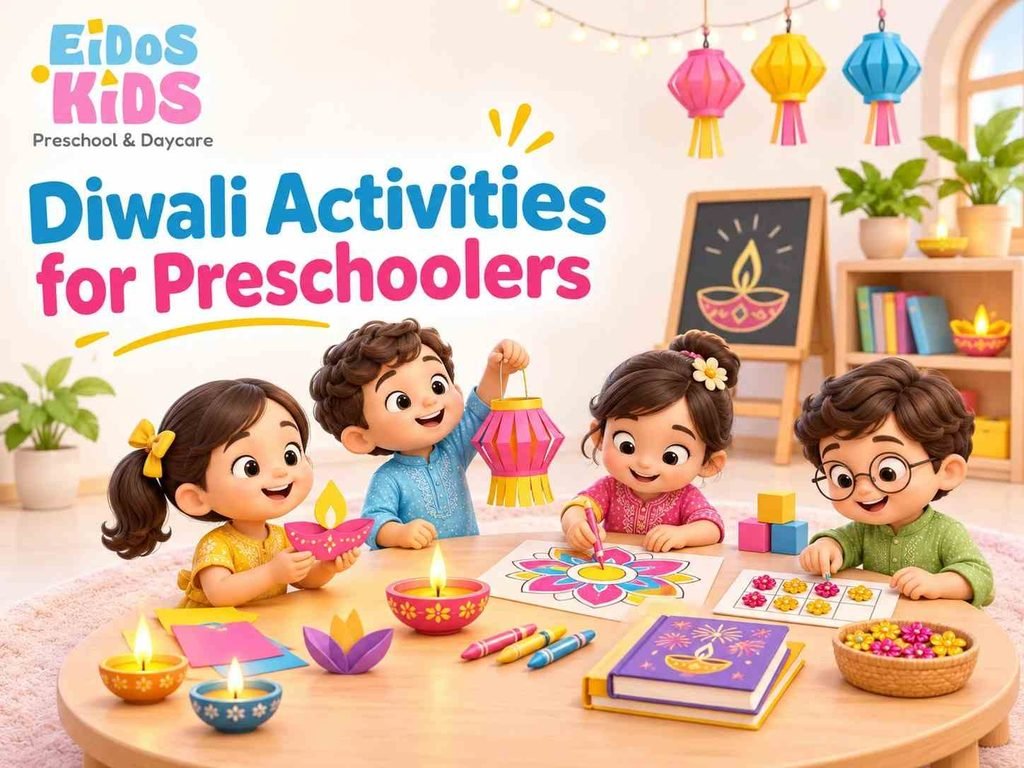
There is something genuinely wonderful about watching a three-year-old discover that a diya they shaped with their own hands can actually hold a flame. That mix of surprise, pride, and curiosity on their face — that is the moment learning becomes a memory. If you are a parent or educator looking to make this festival season meaningful for little ones, you are in the right place. These Diwali celebration activities for kids go far beyond sticker charts and colouring sheets. Each one is designed to build a real skill — fine motor control, creative expression, number sense, language, or social-emotional awareness — wrapped inside the warmth of one of India’s most cherished festivals.
Whether your child is in playgroup, nursery, or kindergarten, the activities below are age-appropriate, low-mess (mostly!), and genuinely engaging. Let’s get into it.
Why Festive Learning Works So Well for Preschoolers
Before jumping into the activities, it is worth understanding why festivals are such a rich learning context for young children.
Preschoolers between the ages of 2 and 6 learn best through experiences that carry emotional meaning. When a child is excited — when there is colour, smell, music, and family energy around them — their brain is in a heightened state of engagement. New information sticks. Connections form. Concepts that might take weeks to introduce through worksheets can land naturally in a single afternoon of festive activity.
This is exactly the principle behind play-based learning at EidosKids — the idea that when children learn through joy and experience, the learning goes deeper and lasts longer.
Diwali, with its rich sensory landscape of lights, rangoli, sweets, stories, and family togetherness, is one of the most naturally powerful learning environments you can create for a young child.
1. Diya Painting and Decoration
What children learn: Fine motor skills, colour recognition, creativity
This one is a classic for good reason. Buy simple clay diyas from your local market — most areas in Pune have them available from early October onward. Set out non-toxic acrylic paints, brushes of different sizes, and some basic sequins or bindis for decoration.
Let children choose their own colours and patterns without direction. Avoid showing them a “right way” to decorate. The child who paints her diya entirely black and then adds gold dots is exercising exactly as much creative thinking as the one who copies a traditional design.
Tip for parents and teachers: Once the diyas are dry, use them during circle time. Ask each child to describe their diya — what colours they chose, why, and what pattern they made. This builds vocabulary and oral expression alongside the craft.
2. Rangoli Making with Coloured Rice or Petals
What children learn: Pattern recognition, spatial awareness, symmetry
Rangoli is visually striking and deeply cultural — but traditional powder rangoli can be tricky and messy for little hands. A wonderful alternative is to use coloured rice (made by mixing dry rice with food colouring) or flower petals.
Draw simple geometric shapes or outlines on chart paper for younger children (ages 2–3). For older preschoolers (4–6), encourage them to come up with their own patterns. Concepts like symmetry, sequence, and repetition emerge very naturally from this activity without any formal instruction.
This kind of structured, hands-on activity is a cornerstone of the holistic education approach that strong early childhood programmes follow — learning that connects the hands, the eyes, and the mind simultaneously.
3. Diwali Storytelling and Puppet Play
What children learn: Language development, listening skills, emotional understanding
The story of Diwali — Rama’s return to Ayodhya, the victory of light over darkness — is rich, dramatic, and full of characters that young children connect with instantly. But instead of just reading it to them, turn it into a puppet show.
Use paper bags, old socks, or cardboard cutouts to create Rama, Sita, Lakshman, Hanuman, and Raavan characters. Let the children narrate and act out scenes in their own words. Do not worry about accuracy — a four-year-old who explains that “Raavan was naughty and took Sita so Ram had to go find her” has grasped both the plot and an important social-emotional concept: actions have consequences.
Storytelling and imaginative play form a significant part of the Playgroup programme at EidosKids, where children as young as 2 begin developing narrative thinking through guided play.
4. Counting and Sorting with Diwali Sweets
What children learn: Early numeracy, sorting, categorisation
Before the mithai gets eaten (let’s be honest, this window is small), put it to educational use. Place a selection of different sweets on a tray — kaju katli, besan ladoos, soan papdi, chocolate barfi — and invite children to sort them by shape, colour, or type.
For younger children, simply counting the pieces (“how many ladoos are there?”) is a meaningful activity. For older ones, you can introduce comparisons: “Are there more kaju katli or more barfi?” or “Can you make two equal groups?”
This kind of concrete number work — using real, meaningful objects — builds early maths foundations far more effectively than abstract number drills.
5. Diwali Card Making and Writing
What children learn: Pre-writing skills, letter formation, social awareness
Ask children to make a Diwali card for someone they care about — a grandparent, a neighbour, a friend from class. Even if a child is not yet writing, they can draw a picture and dictate a message for an adult to write.
For children who are beginning to form letters, this is a wonderful low-pressure writing opportunity. They are motivated by genuine purpose (making someone happy) rather than by the task itself.
The act of thinking about another person — what they might like to see, how to make them feel special — also builds empathy and social awareness, two of the most important skills early childhood education works to develop.
6. Shadow and Light Play with Diyas
What children learn: Scientific observation, curiosity, cause-and-effect thinking
Dim the room and place a lit diya (safely, with adult supervision) near a white wall. Let children observe and explore the shadows it creates. Hold up different objects and watch the shadows change. What happens when you move the diya closer? What happens when you hold your hand between the diya and the wall?
This simple activity introduces concepts from physics — light, shadow, distance, angles — through direct, curious exploration. It also creates a beautiful, calm, slightly magical atmosphere that most preschoolers find completely captivating.
Science exploration at this age is not about right answers. It is about asking “what if?” and finding out. This kind of inquiry-based thinking is woven into our curriculum at EidosKids from the very beginning of a child’s journey with us.
7. Diwali Sensory Bin
What children learn: Sensory processing, vocabulary building, imaginative play
Fill a large bin or tray with materials that evoke Diwali — yellow and orange maize kernels, small tea-light candles (unlit), flower petals, small plastic diyas, coins (for Lakshmi Puja associations), glitter, and small figures.
Let children explore freely. They will pour, sort, bury, and discover. For adults, this is a time to narrate what you observe: “Oh, you found all the gold coins! Are you setting up for Lakshmi Puja?”
Sensory play supports nervous system regulation, fine motor development, and language acquisition all at once. It is also one of the most genuinely enjoyable activities for children who are fidgety or find structured activities challenging.
8. Making Paper Lanterns
What children learn: Following multi-step instructions, spatial reasoning, persistence
Paper lanterns are satisfying to make and genuinely beautiful once complete. Fold a sheet of A4 paper lengthwise, cut slits at regular intervals (a great scissors practice opportunity), unfold, and roll into a tube. Add a handle and a string.
The process involves following a sequence of steps, which is an important skill in itself — sometimes called “executive function” in child development literature. Children who learn to follow multi-step processes without adult correction at every stage become more independent, more confident learners.
For younger children who struggle with the folding, offer a simpler version: just decorate a pre-made lantern outline and staple it into a tube shape. Participation matters more than perfection.
9. Diwali-Themed Dramatic Play Corner
What children learn: Role play, social skills, language, cultural connection
Set up a corner of your home or classroom as a Diwali preparation scene. Include items like: a small puja thali with plastic fruits, play food representing mithai, small pots and decorative items, rangoli patterns to arrange, fabric for dressing up, and pictures of Diwali traditions.
Let children play freely within this space. You will be amazed at how much language they use and how naturally they incorporate what they know about the festival — conversations between “family members,” discussions about what to cook, decisions about which outfit to wear.
Dramatic play is one of the highest-level cognitive activities a preschooler can engage in. It requires memory, language, social negotiation, and imaginative thinking all at once. This is a key part of what the Nursery programme at EidosKids nurtures through carefully designed play environments.
10. Gratitude Sharing Circle
What children learn: Emotional intelligence, self-expression, mindfulness
Diwali is also a time of gratitude — for family, for warmth, for light. End a day of festive activities with a simple circle where each child shares one thing they are grateful for. Use a small diya or a decorated box as a “talking object” that is passed around.
Young children are often more articulate about gratitude than adults expect. “I am grateful for my dog,” “I am grateful for the ladoos,” and “I am grateful for my mummy” are all equally valid and equally meaningful responses.
This practice, done regularly, is linked to improved emotional regulation, better peer relationships, and greater resilience — all outcomes that researchers in early childhood development consistently find associated with emotionally aware educational environments. For further reading on how arts, play, and cultural activities shape child development, the National Association for the Education of Young Children offers excellent evidence-based resources on integrating cultural celebrations into early learning.
A Quick Note on Safety
A few of these activities involve diyas with real flames. Always supervise closely, keep a small bowl of water nearby, and ensure children understand basic fire safety before bringing real candles into an activity. For classroom settings, battery-operated tea lights are a completely safe and equally beautiful alternative.
Conclusion: Diwali Celebration Activities for Kids That Build Real Skills
Festive celebrations are not a break from learning — they are some of the richest learning opportunities available to young children. The 10 Diwali celebration activities for kids shared here are not just crafts to pass the time. Each one builds a real developmental skill: fine motor coordination, early numeracy, language, scientific thinking, creativity, empathy, or emotional intelligence.
When a child paints a diya, they are practising hand-eye coordination and colour concepts. When they sort sweets by shape, they are thinking mathematically. When they make a card for their grandparent, they are developing social awareness. And when they gather for a gratitude circle, they are building the emotional vocabulary that will serve them for life.
At EidosKids, this is precisely how we approach every day — not just Diwali season. Our team brings a deep grounding in developmental psychology to every activity, every transition, and every conversation with children and families. We understand that children aged 2 to 6 are in one of the most neurologically active periods of their entire lives, and we design every learning experience accordingly.
Our programmes — from Playgroup for children aged 2–3 through to Nursery and beyond — are built around the principle that joyful, meaningful experience is the most powerful vehicle for early learning. We use fresh organic meals, zero screens, and an environment designed around how children’s brains actually grow — not around what looks good in a brochure.
If you are looking for a preschool in Baner, Pune that takes your child’s development as seriously as you do, we would love to show you around.