KEY TAKEAWAYS
• Children aged 2 to 5 need 3 to 5 nutritionally dense meals and snacks per day to support the brain development happening during this critical window.
• Fresh organic meals at preschool directly support cognitive function, attention span and emotional regulation in young children.
• Processed, high-sugar school snacks are associated with energy crashes and attention difficulties in preschool-age children, per ICMR nutritional research.
• EidosKids prepares fresh organic meals on-campus daily – no packaged food, no central kitchen delivery, no preserved items.
• The school’s meal programme is not an add-on service. It is one of five founding non-negotiables at EidosKids.
• Children who receive consistent access to nutritionally balanced meals at preschool show measurably better attention spans and learning retention.
• Parents can review the EidosKids weekly menu at any time – transparency in food is part of the school’s overall transparency commitment.
QUICK FACTS
• Daily nutritional needs for children aged 2 to 5: 3 to 5 meals/snacks providing 1,000 to 1,400 calories (ICMR)
• Brain development dependency on nutrition at ages 2 to 5: Critical – 80 percent of adult brain volume develops by age 3 (Industry estimate)
• EidosKids meal preparation: Fresh, on-campus daily – no packaged food
• Organic ingredient sourcing: Local seasonal produce, no artificial additives
• Meal inclusion in fee: Yes – all meals and snacks included in programme fee
• Meal frequency at EidosKids: Morning snack, lunch and afternoon snack for full-day children
Pune Preschool Nutrition Statistics 2025-2026
| Metric | Data | Source |
| Recommended daily calorie intake for age 2 to 5 | 1,000 to 1,400 kcal | ICMR Dietary Guidelines for Indians |
| Protein requirement per day for preschool-age children | 14 to 20g depending on weight | ICMR, NHP India |
| Prevalence of iron deficiency anaemia in Indian under-5s | Approximately 40 percent | NFHS-5 (National Family Health Survey) |
| Impact of mid-day nutritious meal on school attendance and attention | Significantly positive | ICMR and MoHFW combined review |
| Percentage of Indian preschools serving processed packaged snacks | Approximately 70 percent | Industry estimate |
| Brain growth rate ages 0 to 5 relative to adult volume | 80 percent of adult volume by age 3 | Industry estimate, based on neurodevelopment literature |
How EidosKids Supports the DayCare-to-School Transition
| Transition Stage | What Children Experience | How EidosKids Supports |
| First week | New environment, new adults | Phased entry, consistent key worker |
| Weeks 2–3 | Beginning to settle, occasional regression | Patient, predictable daily routine |
| Month 2 | Increasingly confident, peer relationships forming | Gradual expansion of activities |
| Month 3+ | Fully settled, genuine participation | Full programme engagement |
| Year-end | Strong development across all domains | Portfolio review, parent briefing |
Why Nutrition at Preschool Age Is Not Ordinary Nutrition
The 2 to 5-year window is the fastest period of brain development after the first year of life. The neural connections being formed during this period are the ones that will support language, memory, attention, problem-solving and emotional regulation for the rest of the child’s life. These connections require specific nutrients to build correctly and reliably.
Iron deficiency – the most common nutritional deficiency in Indian children under 5, affecting approximately 40 percent of this age group according to NFHS-5 data – directly impairs cognitive development, attention and learning capacity. Omega-3 fatty acids, found in foods like flaxseed, walnuts and certain fish, are essential for the myelin formation that enables fast, efficient neural signalling. Complex carbohydrates provide the steady glucose that the developing brain needs for sustained attention.
When a preschool serves packaged biscuits and juice for morning snack, it is not supporting this biology. It’s working against it. The blood sugar spike from refined carbohydrates produces short-term energy followed by an attention crash – exactly at the time the child should be most engaged.
What ‘Fresh and Organic’ Actually Means in the Context of School Meals
“Organic” is a word that appears in school brochures frequently and means very little unless it’s defined. At EidosKids, organic meals preschool Baner Pune means specifically: all produce is sourced seasonally from local suppliers, ingredients are free from synthetic pesticides and artificial additives, all meals are prepared fresh on-campus that morning and no packaged, preserved or ultraprocessed foods are served.
The meal programme is run from EidosKids’ on-campus kitchen by a trained cook working under the school’s meal policy. The menu is planned weekly by the team with input from Taiba Patel’s nutritional awareness of what preschool-age children’s bodies need. Parents can request and view the weekly menu at any time.
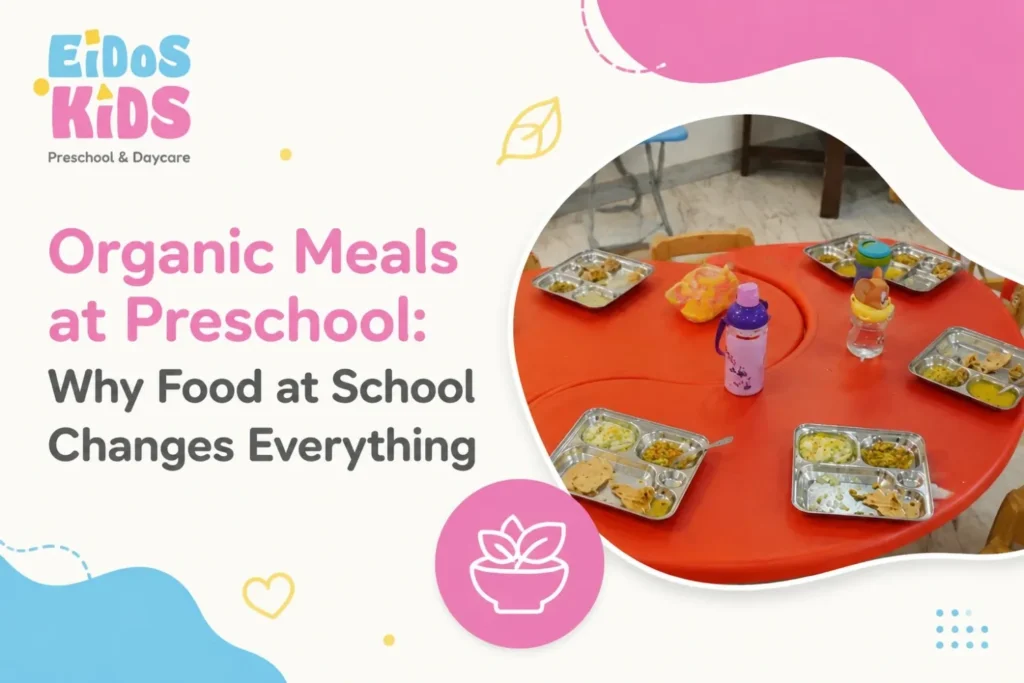
A typical EidosKids lunch for a 3-year-old might include soft-cooked rice or roti, a vegetable dahl rich in iron and protein, a seasonal cooked vegetable side and a fresh fruit portion. This is not restaurant food or Instagram food. It’s nutritionally designed everyday food made from real ingredients.
The Sugar Question at Preschool
Sugar in school food is a sensitive topic because parents know it matters but are rarely given honest information about what their child is eating at school. Most preschool morning snacks – biscuits, packaged juice, flavoured crackers – contain significant amounts of refined sugar and refined flour. These are digested rapidly, producing blood sugar spikes followed by drops that correlate directly with restlessness, crying and inability to focus.
EidosKids’ meal programme does not include refined sugar in its regular menu. Morning snacks are fruit-based or savoury. Lunch is a balanced combination of complex carbohydrate, protein and vegetable. Celebrations and special events may include occasional treats, but these are communicated to parents in advance.
This matters not just for the school day but for the habits children develop. Children who experience a diet of whole foods during their most formative years develop taste preferences and appetite patterns that follow them into primary school and beyond.
How Mealtimes Teach More Than Nutrition
A well-designed mealtime at preschool is also a social learning opportunity. Children sitting together at low tables, serving themselves from shared dishes, saying please and thank you, waiting for others to be served before beginning – these are social and emotional learning experiences that happen every day at EidosKids as part of the meal routine.
Taiba Patel’s developmental framework specifically includes mealtimes as a social skill context. Teachers facilitate conversation at the table, ask children to describe what they’re eating, encourage sharing and model the social rituals of eating together. For many children whose home mealtimes are rushed or screen-accompanied, the school mealtime is their most consistent experience of focused shared eating.
Organic Meals at Preschool in Baner and Surrounding Areas
Baner parents – many of whom work in the health-conscious, research-aware tech industry – are among the most likely to have already questioned what their child is eating. The rise of organic food awareness in Pune’s urban middle class in recent years means many families are already buying organic produce at home. Sending their child to a school that undoes this at lunchtime with packaged food is a disconnect that more Baner parents are noticing.
EidosKids’ meal programme answers this concern directly. The food your child eats at school is held to the same standards as what you’d choose to serve at home. The school is on Baner Road and the kitchen sourcing works with local suppliers in Baner and Pashan for seasonal produce.
Families from Wakad, Sus Road, Balewadi and the Hinjewadi IT corridor who visit EidosKids consistently cite the organic meal programme as one of the most differentiating and personally meaningful features of the school.
Frequently Asked Questions
What do organic meals at preschool in Baner actually include?
At EidosKids, organic meals at preschool Baner Pune include a morning snack (fresh fruit or savoury whole food), a cooked lunch (rice or roti, dahl or protein preparation, seasonal vegetable side) and an afternoon snack for full-day children. All food is prepared fresh on-campus that day using seasonal, locally sourced produce free from artificial additives.
Why does nutrition matter so much at preschool age?
The 2 to 5-year age window is a critical period of brain development. The nutrients children receive during this time directly support the formation of neural connections that underpin attention, language, memory and emotional regulation. Iron, protein, omega-3 fatty acids and complex carbohydrates are particularly important at this stage and a preschool meal programme should provide them reliably.
Is the meal included in EidosKids’ programme fee?
Yes. EidosKids includes all meals – morning snack, lunch and afternoon snack – in its programme fee as part of its radical fee transparency policy. There are no separate meal charges. This applies to both the preschool programmes and the DayCare service.
Are food allergies and dietary requirements accommodated at EidosKids?
Yes. EidosKids requests dietary information from all families during the admissions process and accommodates allergies and dietary requirements within its meal programme. Parents are encouraged to inform the school of any allergy, intolerance or religious dietary requirement so the kitchen can plan accordingly.
What snacks are served at EidosKids and are they sugar-free?
Morning snacks at EidosKids are typically fresh fruit, seasonal vegetables or savoury whole-food items. The meal programme does not include refined sugar in regular daily snacks. Occasional special event foods may differ and are communicated to parents in advance.
Can parents view the weekly menu at EidosKids?
Yes. EidosKids shares the weekly menu with families and parents can request it at any time. Menu transparency is part of the school’s overall commitment to honest communication with families.
Food Is Part of the Curriculum
Organic meals at preschool in Baner Pune are not a premium extra at EidosKids. They’re a founding principle. The decision to serve fresh, organic food every day was made at the same time as the decision to use play-based pedagogy and zero screens – because all of these decisions respond to the same question: what does a 2 to 5-year-old brain actually need?
If you want to see the meal programme – and the rest of what EidosKids has built around that question – book a visit. Come at lunchtime if you can. Bring your questions. And bring your appetite for honesty.
DISCLAIMER
This blog post is for informational purposes only. Parents with children who have diagnosed nutritional conditions, allergies or dietary requirements should consult a qualified paediatrician or dietitian. EidosKids is a registered preschool at Baner Road, Pune 411045.