
Table of Contents
Parents can develop social skills in preschoolers through everyday activities such as pretend play, sharing games, storytelling, group activities, turn-taking, and simple household tasks. These experiences help children aged 3–6 practice communication, cooperation, empathy, and emotional expression. Instead of formal lessons, regular opportunities to interact with family members and other children can help preschoolers gradually understand social situations, build friendships, and become more comfortable expressing their needs.
Why Are Social Skills Important for Preschoolers?
Social skills help young children communicate their thoughts, understand others’ feelings, make friends, and participate in group activities.
During the preschool years, children gradually learn how to:
- Take turns and share materials
- Express needs using words
- Recognise basic emotions
- Cooperate with other children
- Handle small disagreements
- Participate in conversations and group play
These abilities develop at different rates. Some children enjoy group activities, while others need additional time to become comfortable around unfamiliar people.
Developing social skills is not about making every child outgoing. It is about helping children interact confidently and respectfully at their own pace. A supportive preschool environment can provide opportunities for children to develop these skills through play, communication, and everyday interactions. At EidosKids Preschool & Daycare, parents can explore an early learning environment that encourages children’s social, emotional, and overall development.
8 Everyday Activities to Develop Social Skills in Preschoolers
1. Pretend Play and Role-Playing
Pretend play allows children to explore social situations in a familiar environment.
Try this at home: Create a pretend grocery shop, restaurant, or doctor’s clinic. Take turns playing different roles.
Encourage your child to use phrases such as “May I have this?” or “Thank you.”
This activity offers opportunities to practise conversation, cooperation, and understanding different perspectives.
2. Turn-Taking Games
Waiting for a turn can be challenging for young children, particularly when they are excited about an activity.
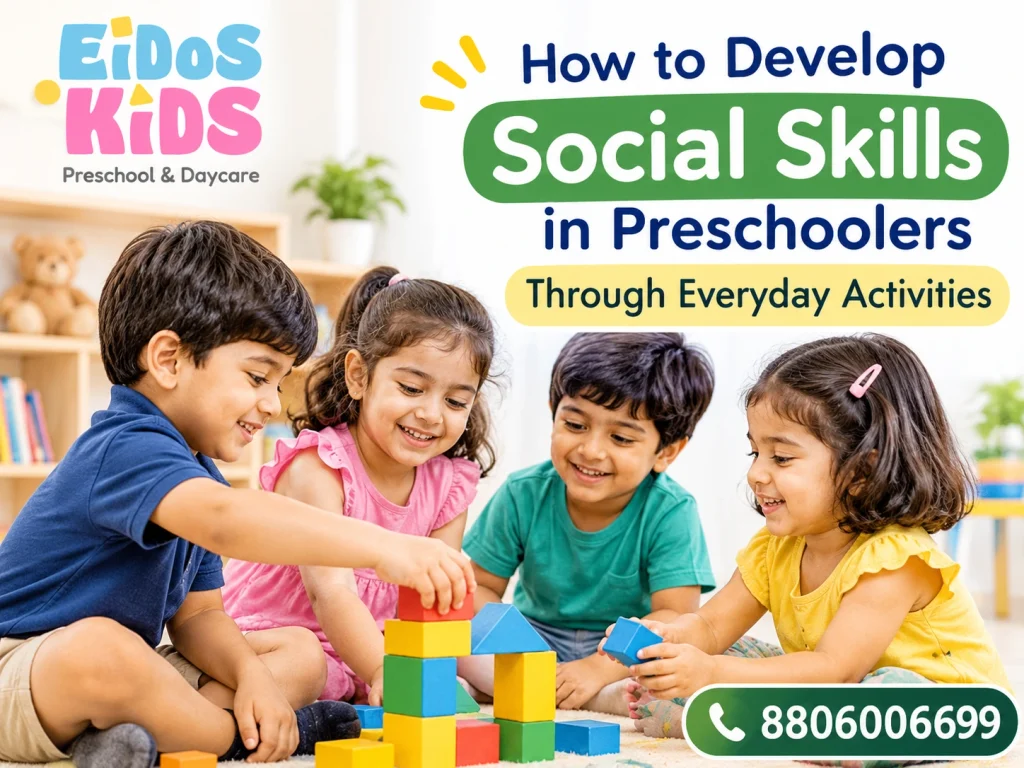
Simple board games, rolling a ball, or building a tower together can introduce turn-taking.
Parent tip: Use clear phrases such as “My turn, then your turn.” Begin with short waiting periods and gradually increase them as your child becomes comfortable.
3. Storytelling About Feelings
Stories provide opportunities to discuss emotions without placing children in uncomfortable situations.
Choose picture books featuring friendship, helping, disappointment, or kindness.
Ask questions such as:
- How do you think the character feels?
- Why was the character upset?
- What could their friend do to help?
Allow children to express their own interpretations rather than expecting one correct answer.
4. Playing With Other Children
Playdates and small-group activities give children opportunities to practise communication and cooperation.
Start with one familiar child and offer simple activities such as building blocks, drawing, or outdoor games.
Adults can remain nearby to guide interactions when needed, but children should also have opportunities to solve manageable disagreements themselves.
5. Helping With Household Tasks
Everyday responsibilities can introduce teamwork and cooperation.
Ask your child to help arrange plates, water plants, organise toys, or prepare materials for an activity.
Use phrases such as “Let’s do this together” and acknowledge their contribution.
These shared experiences can help children understand cooperation and responsibility.
6. Emotion Recognition Games
Recognising emotions is an important part of understanding social situations.
Draw simple faces showing happiness, sadness, anger, and surprise.
Ask your child to identify each emotion and describe a situation when someone might feel that way.
You can also talk about feelings during everyday experiences, such as losing a game or receiving help.
7. Group Music and Movement
Action songs, circle games, and dancing encourage children to participate alongside others.
Activities involving clapping patterns, following movements, or passing an object can provide opportunities to practise listening, coordination, and cooperation.
Keep participation voluntary, especially for children who are initially hesitant.
8. Practising Everyday Conversations
Short daily conversations help children become familiar with listening and responding.
During meals or playtime, ask open-ended questions such as:
- What made you happy today?
- What would you like to play tomorrow?
- How could you ask a friend to join your game?
Give your child enough time to respond without completing every sentence for them.
These interactions support communication and confidence.
What Social Skills Can Parents Expect at Different Ages?
Children develop social abilities gradually, and individual differences are normal.
| Age | Commonly Emerging Social Skills |
|---|---|
| 3 years | Showing interest in other children, joining simple play, expressing basic feelings |
| 4 years | Participating in pretend play, forming friendships, taking turns with support |
| 5–6 years | Cooperating in group activities, discussing feelings, negotiating simple disagreements |
These are general developmental patterns, not strict requirements. Language development, temperament, and previous social experiences can influence how children interact.
Parents exploring early learning opportunities can learn more about the play-based programmes offered at EidosKids Preschool & Daycare in Baner.
How Can Parents Encourage Social Skills at Home?
Social development happens through regular interaction rather than formal teaching alone.
Model respectful communication: Children learn by observing how adults speak, listen, apologise, and respond to others.
Avoid forcing children to share: Support turn-taking and explain why another child may also want to use a toy.
Provide opportunities for interaction: Visits to parks, family gatherings, and small playgroups can introduce different social situations.
Acknowledge emotions: Help your child name feelings before discussing appropriate responses.
Encourage independence: Allow children to make simple choices and attempt age-appropriate tasks.
Avoid comparisons: A quiet child may still develop healthy friendships and communication skills.
How Does Preschool Support Social Skills Development?
Preschools provide regular opportunities for children to interact with peers beyond their immediate family.
Through collaborative play, storytelling, creative activities, and shared routines, children can practise communication, cooperation, and emotional understanding.
Teachers can support these experiences by modelling respectful language, helping children express their feelings, and guiding them through disagreements.
At EidosKids Preschool & Daycare in Baner, the educational approach emphasises play-based learning and social-emotional development. Parents can explore the school’s educational philosophy and child-centred approach to understand how these principles are incorporated into early childhood education.
What If Your Preschooler Struggles With Social Interaction?
Not every preschooler immediately enjoys group activities. Some children prefer observing before joining, while others feel more comfortable playing with familiar friends.
Parents can support them by introducing social situations gradually, allowing preparation time, and recognising small improvements.
However, if a child consistently has difficulty communicating, responding to social interactions, or participating in everyday activities, discussing these concerns with a paediatrician or qualified child development professional may be helpful.
The aim is to understand the child’s individual needs rather than label their behaviour.
Frequently Asked Questions
1. What are the best activities to improve social skills in preschoolers?
Pretend play, turn-taking games, storytelling, playdates, and cooperative household activities provide opportunities to practise communication, sharing, empathy, and teamwork.
2. How can I help my shy preschooler make friends?
Begin with short playdates involving one familiar child. Provide enjoyable shared activities and allow your child to participate at their own pace without pressure.
3. At what age do children start developing social skills?
Social development begins in infancy. During the preschool years, children generally develop more complex communication, cooperation, friendship, and emotional understanding skills.
4. Can preschool help children develop social confidence?
Preschool can offer opportunities for peer interaction, cooperative play, communication, and guided problem-solving. Progress varies according to each child’s developmental needs and experiences.
Conclusion
Helping children develop social skills does not require complicated activities or strict schedules. Everyday experiences such as playing together, talking about feelings, taking turns, and participating in family routines create valuable learning opportunities.
With patient guidance and regular interaction, children can gradually develop communication, cooperation, empathy, and confidence.
Parents interested in understanding how social development and play-based learning are supported at EidosKids Preschool & Daycare can contact the school team for information about its programmes and learning environment.