- playgroup curriculum Baner Pune activities is designed to develop a specific domain: language, motor, social, sensory or cognitive
- Playgroup is not preparation for school – it is education itself, appropriate for ages 1.5 to 2.5
- A quality Playgroup does not use worksheets, screens or rote repetition
- Consistent weekly routines help toddlers build security, predict what comes next and participate confidently
- At EidosKids, the playgroup curriculum Baner Pune is designed by educators with a Counselling Psychology and Environmental Architecture background
INTRODUCTION
Parents dropping their toddler off at Playgroup for the first time often wonder: what exactly is happening in there? It looks like play. It is play. But it is also carefully designed developmental practice – and understanding this changes how you see the time your child spends at school. This guide walks through what a quality Playgroup curriculum looks like week by week, what developmental purpose each activity serves and why none of it involves worksheets or screens.
Quick Facts:
- Playgroup children aged 1.5 to 2.5 are in the fastest period of brain development they will ever experience
- Play is the primary learning mode for children under 3 – there is no more effective educational approach
- A quality Playgroup session of 3 hours can cover all five developmental domains if planned correctly
- Toddlers need 150+ minutes of active play per day for healthy development (WHO)
- Daily routines and rituals in Playgroup reduce anxiety and build independence
- Social play begins in earnest around age 2 – Playgroup provides the peer environment for this to develop
Statistics
| Metric | Data | Source |
| Brain synapses formed per second in toddlerhood | Over 1 million | UNICEF |
| % of learning that occurs through play at age 2 | Over 85% | NCERT |
| Physical activity recommendation for toddlers daily | 180 min total, 30 min vigorous | WHO |
| Vocabulary learned through shared storybook reading | 15–20% more than non-readers | PubMed |
| Impact of sensory play on cognitive development | Positive correlation | PubMed |
| Children showing better self-regulation after structured Playgroup | ~60% by age 4 | Industry estimate |
| Preschools in Baner offering structured Playgroup | ~20 | Industry estimate |
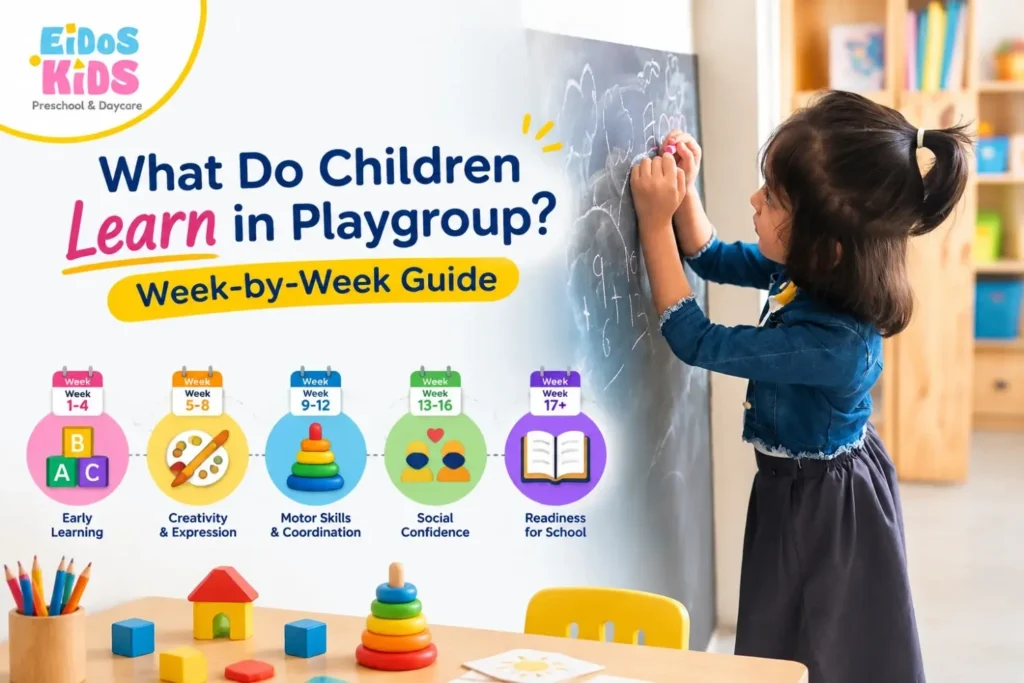
Week-by-Week Playgroup Learning Focus
| Weeks | Theme | Developmental Focus | Sample Activities |
| 1–2 | Orientation | Trust, safety, environment familiarity | Free exploration, morning greeting rituals |
| 3–5 | Sensory play | Sensory processing, fine motor, vocabulary | Water, sand, dough, natural materials |
| 6–8 | Music and movement | Gross motor, phonological awareness, rhythm | Action songs, simple instruments, clapping |
| 9–11 | Creative play | Fine motor, self-expression, confidence | Painting, collage, large-format art |
| 12–14 | Story and language | Vocabulary, narrative, early literacy | Read-aloud, puppets, story retelling |
| 15+ | Integration | All five domains simultaneously | Cooking, building, dramatic play |
Week-by-Week Learning Focus: Playgroup Term Overview
| Weeks | Theme | Developmental Focus | Sample Activities |
| 1–2 | Orientation | Trust, safety, familiarity | Free exploration, greeting rituals |
| 3–5 | Sensory play | Sensory processing, fine motor, vocabulary | Water, sand, dough, natural materials |
| 6–8 | Music and movement | Gross motor, phonological awareness | Action songs, instruments, rhythm |
| 9–11 | Creative play | Fine motor, self-expression, confidence | Painting, collage, free drawing |
| 12–14 | Story and language | Vocabulary, narrative, early literacy | Read-aloud, puppet stories, retelling |
| 15+ | Integration | All domains simultaneously | Cooking, building, dramatic play |
The Playgroup Curriculum Baner Pune: What It Is And Is Not
A playgroup curriculum Baner Pune is not a schedule of lessons. It is a planned sequence of experiences designed to support the developmental needs of children aged 18 months to 2.5 years.
What it is: A framework of intentional activities – sensory play, music, movement, art, story, outdoor exploration and social interaction – planned around developmental goals and delivered through play.
What it is not: Worksheets. Letter drills. Number repetition. Screen time. Any activity designed to make a 2-year-old “ready for KG.” A child who can recite the alphabet before age 3 has not been educated – they have been drilled.
The EidosKids Playgroup curriculum Baner Puneis built around five developmental domains: sensory and physical, language and communication, cognitive and creative, social and emotional and independence and self-care.
Week-By-Week: What A Term Looks Like
WEEKS 1–2: ORIENTATION AND SETTLING
The curriculum formally begins with the child’s transition into the school environment. Activities in these weeks prioritise familiarity and safety: free exploration of the classroom, introduction to classroom rituals (morning greeting, circle time, goodbye song), sensory play with materials the child can return to.
Developmental goal: Trust, safety, familiarity with environment and caregivers.
WEEKS 3–5: SENSORY EXPLORATION
Once children are settled, the curriculum introduces richer sensory experiences: water play, sand play, dough and clay, textured surfaces and natural materials. Teachers narrate what children are doing, introducing vocabulary in context.
Developmental goal: Sensory processing, fine motor development, early vocabulary through narrated exploration.
WEEKS 6–8: MUSIC AND MOVEMENT
Action songs, simple instruments, clapping rhythms and body movement activities. At this age, music is not performance – it is rhythmic, repetitive, joyful movement that builds coordination, phonological awareness and social engagement.
Developmental goal: Gross motor coordination, phonological awareness, social participation.
WEEKS 9–11: CREATIVE PLAY
Finger painting, large-format art, collage with natural materials, free drawing. No colouring-in pages with a “right answer.” Open-ended creative activities develop fine motor control, decision-making and the confidence to make and show things.
Developmental goal: Fine motor skills, creative expression, self-confidence.
WEEKS 12–14: STORY AND LANGUAGE
Daily read-aloud sessions become increasingly interactive. Children are invited to point at pictures, anticipate repeated phrases, name characters and eventually retell simple sequences. Storytelling through play begins – setting up scenarios with small figures or puppets.
Developmental goal: Vocabulary growth, narrative comprehension, early literacy readiness.
Weeks 15 Onward: Integration And Complexity
By this point, activities begin to integrate multiple domains simultaneously. A cooking activity, for example, involves following instructions (cognitive), fine motor work (physical), vocabulary (language), waiting for turns (social-emotional) and sensory engagement.
The Daily Structure: Predictability As A Developmental Tool
For children aged 18 months to 2.5 years, predictability is not boring – it is deeply reassuring. When a child knows that arrival is followed by free play, then circle time, then a main activity, then outdoor time, then snack, then a story and then goodbye, they are free to participate fully rather than spending energy on anxiety about what comes next.
This is why EidosKids follows a consistent daily rhythm throughout the year, with seasonal and thematic variations in specific activities. The rhythm stays the same; the content evolves with the children.
How Teachers Observe And Document Development
In a quality Playgroup, teachers are not just facilitating activities – they are observing, recording and responding. Every significant developmental milestone, social interaction and breakthrough is noted. This documentation informs the next week’s planning (if a group of children is particularly engaged in water play, the teacher builds on this) and forms the basis of parent communication.
At EidosKids, developmental documentation is structured and ongoing. Parents receive regular updates on where their child is across each domain – not a report card, but a developmental narrative.
Local Context: Toddler Learning In Baner Families
Many Baner families starting Playgroup are also navigating the move from primarily home-based care (grandparents, nannies or a parent at home) to a school setting for the first time. The playgroup curriculum Baner Pune at EidosKids is designed to bridge this transition – beginning with activities that feel familiar (sensory play, songs) before building toward more complex group interactions.
Parents from Pashan, Balewadi and Sus Road often ask whether Playgroup content is “basic” compared to more academic preschools nearby. The answer: Playgroup content is exactly as sophisticated as it needs to be for brain development at this age. Trying to accelerate beyond developmentally appropriate content does not produce smarter children – it produces anxious ones.
FAQ
Is there any academic content in the EidosKids Playgroup?
Not in the traditional sense. There are no letter or number drills. There is rich language exposure, storytelling, counting in context and pattern recognition through play – which is the appropriate academic foundation for this age.
My child comes home and says they “just played.” Is that enough?
Yes. Play is the developmental work of early childhood. If you ask what happened today and get a story about building with blocks or making dough shapes, that is evidence of a well-designed Playgroup.
How does EidosKids communicate what my child did during Playgroup?
Teachers provide regular updates through daily notes and scheduled parent meetings. The school communicates developmental observations in plain language, not educational jargon.
Does EidosKids Playgroup follow any specific framework?
The programme is developed by the school’s co-founders, drawing on established developmental frameworks including NCERT’s Early Childhood Education guidelines. The approach is play-based and child-led within a structured daily rhythm.
How big are Playgroup groups at EidosKids?
EidosKids keeps Playgroup group sizes small to ensure adequate individual attention for each toddler. Contact the school for current group sizes.
What if my child is particularly advanced? Will the Playgroup content be too simple?
Playgroup activities are open-ended – a child who is ready for more complexity will find it within the same activity that a less experienced child approaches more simply. Good early childhood educators adjust within activities, not between them.
Can I observe a Playgroup session before admitting my child?
Yes. EidosKids welcomes parent visits during school hours as part of the admissions process. Book a visit.
CONCLUSION
Playgroup is not daycare with songs. It is a structured developmental curriculum delivered through the only vehicle appropriate for a 2-year-old: purposeful, joyful play. Every week builds on the last. Every activity serves a specific developmental purpose. And every child leaves the year more capable, more confident and more ready for what comes next than when they arrived.
EidosKids Playgroup is built by educators who understand this – and it shows in how children arrive on the last day of term compared to the first.
DISCLAIMER
The curriculum descriptions in this article are representative of a quality Playgroup framework. Specific activities and scheduling at EidosKids may vary. Contact the school for current programme details.